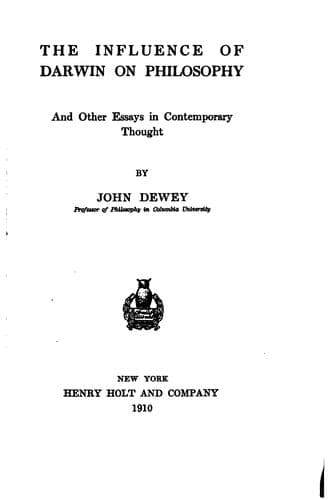
The Influence of Darwin on Philosophy, and other essays in contemporary thoughtDewey, John
Philosophy
The Influence of Darwin on Philosophy, and other essays in contemporary thought
Dewey, John
Evolution; Philosophy; Pragmatism
Such a standpoint promises ample revenge for the long damnation and
longer neglect to which the principle of belief has been subjected.
The whole procedure of thinking as developed in those extensive and
intensive inquiries that constitute the sciences, is but rendering
into a systematic technique, into an art deliberately and delightfully
pursued, the rougher and cruder means by which practical human beings
have in all ages worked out the implications of their beliefs, tested
them, and endeavored in the interests of economy, efficiency, and
freedom, to render them coherent with one another. Belief, sheer,
direct, unmitigated belief, reappears as the working hypothesis; action
that at once develops and tests belief reappears in experimentation,
deduction, demonstration; while the machinery of universals, axioms,
_a priori_ truths, etc., becomes a systematization of the way in which
men have always worked out, in anticipation of overt action, the
implications of their beliefs, with a view to revising them, in the
interests of obviating unfavorable, and securing welcome consequences.
Observation, with its machinery of sensations, measurements, etc.,
is the resurrection of the way in which agents have always faced and
tried to define the problems that face them; truth is the union of
abstract postulated meanings and of concrete brute facts in a way that
circumvents the latter by judging them from a new standpoint, while it
tests concepts by using them as methods in the same active experience.
It all comes to experience personally conducted and personally
consummated.
Let consciousness of these facts dawn a little more brightly over the
horizon of epistemological prejudices, and it will be seen that nothing
prevents admitting the genuineness both of thinking activities and of
their characteristic results, except the notion that belief itself is
not a genuine ingredient of existence--a notion which itself is not
only a belief, but a belief which, unlike the convictions of the common
man and the hypotheses of science, finds its proud proof in the fact
that it does not demean itself so unworthily as to work.
Public-domain text, read in full here on John Shaqi.
Reviews
Reviews
No reviews yet
Be the first to share your thoughts on this work.
Elsewhere in the archive
Join the Discussion
Join the discussion
Sign in to leave a comment or review.
Sign InorCreate an account