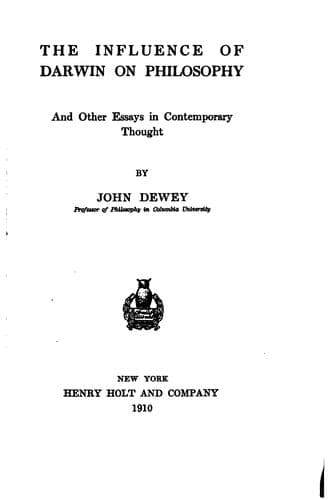
The Influence of Darwin on Philosophy, and other essays in contemporary thoughtDewey, John
Philosophy
The Influence of Darwin on Philosophy, and other essays in contemporary thought
Dewey, John
Evolution; Philosophy; Pragmatism
Once believe that beliefs themselves are as “real” as anything else
can ever be, and we have a world in which uncertainty, doubtfulness,
really inhere; and in which personal attitudes and responses are real
both in their own distinctive existence, and as the only ways in which
an as yet undetermined factor of reality takes on shape, meaning,
value, truth. If “to wilful men the injuries that they themselves
procure, must be their schoolmasters”--and all beliefs are wilful--then
by the same token the propitious evolutions of meaning, which wilful
men secure to an expectant universe, must be their compensation and
their justification. In a doubtful and needy universe elements must be
beggarly, and the development of personal beliefs into experimentally
executed systems of actions, is the organized bureau of philanthropy
which confers upon a travailing universe the meaning for which it cries
out. The apostrophe of the poet is above all to man the thinker, the
inquirer, the knower:
O Dreamer! O Desirer, goer down
Unto untraveled seas in untried ships,
O crusher of the unimagined grape,
On unconceivèd lips.
2. Biology, psychology, and the social sciences proffer an imposing
body of concrete facts that also point to the rehabilitation of
belief--to the interpretation of knowledge as a human and practical
outgrowth of belief, not to belief as the state to which knowledge is
condemned in a merely finite and phenomenal world. I need not, as I
cannot, here summarize the psychological revision which the notions of
sensation, perception, conception, cognition in general have undergone,
all to one intent. “Motor” is writ large on their face. The testimony
of biology is unambiguous to the effect that the organic instruments
of the whole intellectual life, the sense-organs and brain and their
connections, have been developed on a definitely practical basis and
for practical aims, for the purpose of such control over conditions
as will sustain and vary the meanings of life. The historic sciences
are equally explicit in their evidence that knowledge as a system of
information and instruction is a coöperative social achievement, at
all times socially toned, sustained, and directed; and that logical
thinking is a reweaving through individual activity of this social
fabric at such points as are indicated by prevailing needs and aims.
Public-domain text, read in full here on John Shaqi.
Reviews
Reviews
No reviews yet
Be the first to share your thoughts on this work.
Elsewhere in the archive
Join the Discussion
Join the discussion
Sign in to leave a comment or review.
Sign InorCreate an account