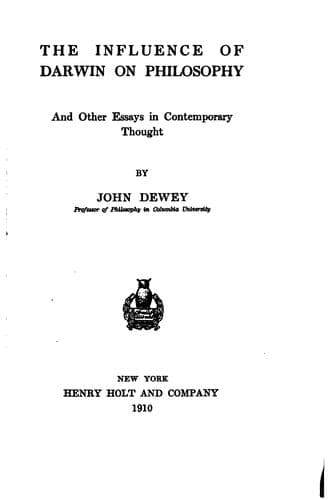
The Influence of Darwin on Philosophy, and other essays in contemporary thoughtDewey, John
Philosophy
The Influence of Darwin on Philosophy, and other essays in contemporary thought
Dewey, John
Evolution; Philosophy; Pragmatism
For one, I have no interest in the old, old scheme of derogating from
the worth of knowledge in order to give an uncontrolled field for some
_special_ beliefs to run riot in,--be these beliefs even faith in
immortality, in some special sort of a Deity, or in some particular
brand of freedom. Any one of our beliefs is subject to criticism,
revision, and even ultimate elimination through the development of its
own implications by intelligently directed action. Because reason is
a scheme of working out the meanings of convictions in terms of one
another and of the consequences they import in further experience,
convictions are the more, not the less, amenable and responsible to the
full exercise of reason.[29]
Thus we are put on the road to that most desirable thing,--the union
of acknowledgment of moral powers and demands with thoroughgoing
naturalism. No one really wants to lame man’s practical nature; it is
the supposed exigencies of natural science that force the hand. No one
really bears a grudge against naturalism for the sake of obscurantism.
It is the need of some sacred reservation for moral interests that
coerces. We all want to be as naturalistic as we can be. But the “can
be” is the rub. If we set out with a fixed dualism of belief and
knowledge, then the uneasy fear that the natural sciences are going
to encroach and destroy “spiritual values” haunts us. So we build
them a citadel and fortify it; that is, we isolate, professionalize,
and thereby weaken beliefs. But if beliefs are the most natural, and
in that sense, the most metaphysical of all things, and if knowledge
is an organized technique for working out their implications and
interrelations, for directing their formation and employ, how
unnecessary, how petty the fear and the caution. Because freedom of
belief is ours, free thought may exercise itself; the freer the thought
the more sure the emancipation of belief. Hug some special belief and
one fears knowledge; believe in belief and one loves and cleaves to
knowledge.
We have here, too, the possibility of a common understanding, in
thought, in language, in outlook, of the philosopher and the common
man. What would not the philosopher give, did he not have to part
with some of his common humanity in order to join a class? Does he
not always, when challenged, justify himself with the contention that
all men naturally philosophize, and that he but does in a conscious
and orderly way what leads to harm when done in an indiscriminate
and irregular way? If philosophy be at once a natural history _and_
a logic--an art--of beliefs, then its technical justification is at
one with its human justification. The natural attitude of man, said
Emerson, is believing; “the philosopher, after some struggle, having
only reasons for believing.” Let the struggle then enlighten and
enlarge beliefs; let the reasons kindle and engender new beliefs.
Public-domain text, read in full here on John Shaqi.
Reviews
Reviews
No reviews yet
Be the first to share your thoughts on this work.
Elsewhere in the archive
Join the Discussion
Join the discussion
Sign in to leave a comment or review.
Sign InorCreate an account