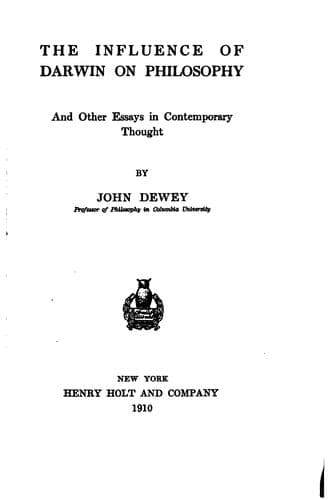
The Influence of Darwin on Philosophy, and other essays in contemporary thoughtDewey, John
Philosophy
The Influence of Darwin on Philosophy, and other essays in contemporary thought
Dewey, John
Evolution; Philosophy; Pragmatism
I have suggested to you the naïve conception of the relation of beliefs
to realities: that beliefs are themselves real without discount,
manifesting their reality in the usual proper way, namely, by modifying
and shaping the reality of other things, so that they connect the bias,
the preferences and affections, the needs and endeavors of personal
lives with the values, the characters ascribed to things:--the latter
thus becoming worthy of human acquaintance and responsive to human
intercourse. This was followed by a sketch of the history of thought,
indicating how beliefs and all they insinuate were subjected to
preconceived notions of knowledge and of “reality” as a monopolistic
possession of pure intellect. Then I traced some of the _motifs_ that
make for reconsideration of the supposed uniquely exclusive relation
of logical knowledge and “reality”; _motifs_ that make for a less
invidiously superior attitude towards the convictions of the common man.
In concluding, I want to say a word or two to mitigate--for escape is
impossible--some misunderstandings. And, to begin with, while possible
doubts inevitably troop with actual beliefs, the doctrine in question
is not particularly sceptical. The radical empiricist, the humanist,
the pragmatist, label him as you will, believes not in fewer but in
more “realities” than the orthodox philosophers warrant. He is not
concerned, for example, in discrediting objective realities and logical
or universal thinking; he is interested in such a reinterpretation of
the sort of “reality” which these things possess as will accredit,
without depreciation, concrete empirical conscious centers of action
and passion.
My second remark is to the opposite effect. The intent is not
especially credulous, although it starts from and ends with the radical
credulity of all knowledge. To suppose that because the sciences are
ultimately instrumental to human beliefs, we are therefore to be
careless of the most exact possible use of extensive and systematic
scientific methods, is like supposing that because a watch is made to
tell present time, and not to be an exemplar of transcendent, absolute
time, watches might as well be made of cheap stuffs, casually wrought
and clumsily put together. It is the task of telling present time, with
all its urgent implications, that brings home, steadies, and enlarges
the responsibility for the best possible use of intelligence, the
instrument.
Public-domain text, read in full here on John Shaqi.
Reviews
Reviews
No reviews yet
Be the first to share your thoughts on this work.
Elsewhere in the archive
Join the Discussion
Join the discussion
Sign in to leave a comment or review.
Sign InorCreate an account