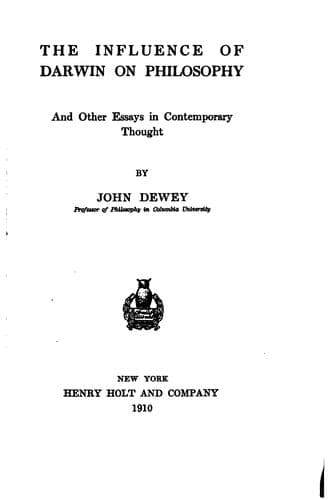
The Influence of Darwin on Philosophy, and other essays in contemporary thoughtDewey, John
Philosophy
The Influence of Darwin on Philosophy, and other essays in contemporary thought
Dewey, John
Evolution; Philosophy; Pragmatism
The second historic event centers about the controversy of innate
ideas, or pure concepts. The issue is between empiricism and
rationalism as theories of the origin and validation of scientific
knowledge. The empiricist is he who feels that the chief obstacle
which prevents scientific method from making way is the belief in
pure thoughts, not derived from particular observations and hence not
responsible to the course of experience. His objection to the “high _a
priori_ road” is that it introduces in irresponsible fashion a mode
of presumed knowledge which may be used at any turn to stand sponsor
for mere tradition and prejudice, and thus to nullify the results of
science resting upon and verified by observable facts. Experience
thus comes to mean, to use the words of Peirce, “that which is forced
upon a man’s recognition will-he, nill-he, and shapes his thoughts
to something quite different from what they naturally would have
taken.”[31] The same definition is found in James, in his chapter on
Necessary Truths: “Experience means experience of something foreign
supposed to impress us whether spontaneously or in consequence of our
own exertions and acts.”[32] As Peirce points out, this notion of
experience as the foreign element that forces the hand of thought and
controls its efficacy, goes back to Locke. Experience is “observation
employed either about external sensible objects, or about the internal
operations of our minds”[33]--as furnishing in short all the valid
data and tests of thinking and knowledge. This meaning, thinks Peirce,
should be accepted “as a landmark which it would be a crime to disturb
or displace.”
The contention of idealism, here bound up with rationalism, is that
perception and observation cannot guarantee knowledge in its honorific
sense (science); that the peculiar differentia of scientific knowledge
is a constancy, a universality, and necessity that contrast at every
point with perceptual data, and that indispensably require the
function of conception.[34] In short, _qualitative transformation_
of _facts_ (data of perception), not their mechanical subtraction
and recombination, is the difference between scientific and
perceptual knowledge. Here the problem which emerges is, of course,
the significance of perception and of conception in respect to
experience.[35]
Public-domain text, read in full here on John Shaqi.
Reviews
Reviews
No reviews yet
Be the first to share your thoughts on this work.
Elsewhere in the archive
Join the Discussion
Join the discussion
Sign in to leave a comment or review.
Sign InorCreate an account