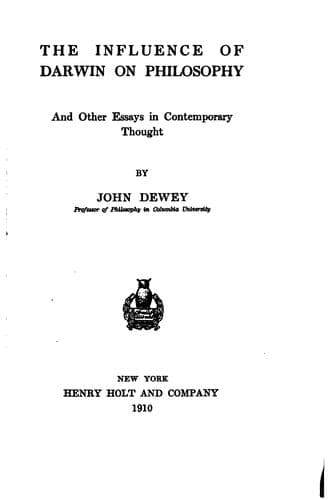
The Influence of Darwin on Philosophy, and other essays in contemporary thoughtDewey, John
Philosophy
The Influence of Darwin on Philosophy, and other essays in contemporary thought
Dewey, John
Evolution; Philosophy; Pragmatism
The third episode reverses in a curious manner (which confuses present
discussion) the notion of experience as a foreign, alien, coercive
material. It regards experience as a fortuitous association, by merely
psychic connections, of individualistic states of consciousness.
This is due to the Humian development of Locke. The “objects”
and “operations,” which to Locke were just given and secured in
observation, become shifting complexes of subjective sensations and
ideas, whose apparent permanency is due to discoverable illusions.
This, of course, is the empiricism which made Kant so uneasily toss
in his dogmatic slumbers (a tossing that he took for an awakening);
and which, by reaction, called out the conception of thought as a
function operating both to elevate perceptual data to scientific
status, and also to confer objective status, or knowable character,
upon even sensational data and their associative combinations.[36]
Here emerges the third element in our problem: The function of thought
as furnishing objectivity to any experience that claims cognitive
reference or capacity.
Summing up the matter, idealism stands forth with its assertion of
thought or reason as (1) the sponsor for all significance, ideality,
purpose, in experience,--the author of the good and the beautiful
as well as the true; (2) the power, located in pure conceptions,
required to elevate perceptive or observational material to the plane
of science; and (3) the constitution that gives objectivity, even the
semblance of order, system, connection, mutual reference, to sensory
data that without its assistance are mere subjective flux.
II
I begin the discussion with the last-named function. Thought is
here conceived as _a priori_, not in the sense of particular innate
ideas, but of a function that constitutes the very possibility
of any objective experience, any experience involving reference
beyond its own mere subjective happening. I shall try to show that
idealism is condemned to move back and forth between two inconsistent
interpretations of this _a priori_ thought. It is taken to mean both
the organized, the regulated, the informed, established character
of experience, an order immanent and constitutional; and an agency
which organizes, regulates, forms, synthesizes, a power operative and
constructive. And the oscillation between and confusion of these two
diverse senses is necessary to Neo-Kantian idealism.
Public-domain text, read in full here on John Shaqi.
Reviews
Reviews
No reviews yet
Be the first to share your thoughts on this work.
Elsewhere in the archive
Join the Discussion
Join the discussion
Sign in to leave a comment or review.
Sign InorCreate an account