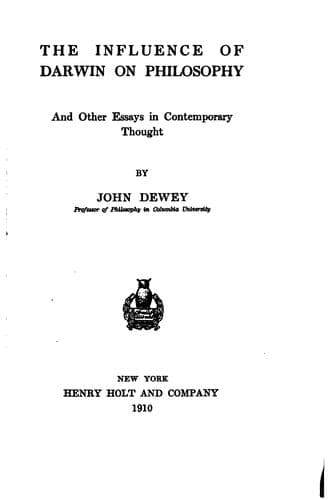
The Influence of Darwin on Philosophy, and other essays in contemporary thoughtDewey, John
Philosophy
The Influence of Darwin on Philosophy, and other essays in contemporary thought
Dewey, John
Evolution; Philosophy; Pragmatism
In short, (_a_) _a priori_ character is no exclusive function of
thought. Every biological function, every motor attitude, every vital
impulse as the carrying vehicle of experience is thus _apriorily_
regulative in prospective reference; what we call apperception,
expectation, anticipation, desire, demand, choice, are pregnant with
this constitutive and organizing power. (_b_) In so far as “thought”
does exercise such reorganizing power, it is because thought is itself
still a _vital_ function. (_c_) Objective idealism depends not only
upon ignoring the existence and capacity of vital functions, but upon a
profound confusion of the constitutional _a priori_, the unconsciously
dominant, with empirically reflective thought. In the sense in which
the _a priori_ is worth while as an attribute of thought, thought
cannot be what the objective idealist defines it as being. Plain,
ordinary, everyday empirical reflections, operating as centers of
inquiry, of suggestion, of experimentation, exercise the valuable
function of regulation, in an auspicious direction, of subsequent
experiences.
The categories of accomplished systematization cover alike the just
and the unjust, the false and the true, while (unlike God’s rain) they
exercise no _specific_ or _differential_ activity of stimulation and
control. Error and inefficiency, as well as value and energy, are
embodied in our objective institutional classifications. As a special
favor, will not the objective idealist show how, in some one single
instance, his immanent “reason” makes any difference as respects
the detection and elimination of error, or gives even the slightest
assistance in discovering and validating the truly worthful? This
practical work, the life blood of intelligence in everyday life and
in critical science, is done by the despised and rejected matter of
concrete empirical contexts and functions. Generalizing the issue: If
the immanent organization be ascribed to thought, why should its work
be such as to demand continuous correction and revision? If specific
reflective thought, as empirical, be subject to all the limitations
supposed to inhere in experience as such, how can it assume the burden
of making good, of supplementing, reconstructing, and developing
meanings? The logic of the case seems to be that Neo-Kantian idealism
gets its status against empiricism by first accepting the Humian idea
of experience, while the express import of its positive contribution
is to show the _non-existence_ (not merely the cognitive invalidity)
of anything describable as mere states of subjective consciousness.
Thus in the end it tends to destroy itself and to make way for a more
adequate empiricism.
III
Public-domain text, read in full here on John Shaqi.
Reviews
Reviews
No reviews yet
Be the first to share your thoughts on this work.
Elsewhere in the archive
Join the Discussion
Join the discussion
Sign in to leave a comment or review.
Sign InorCreate an account