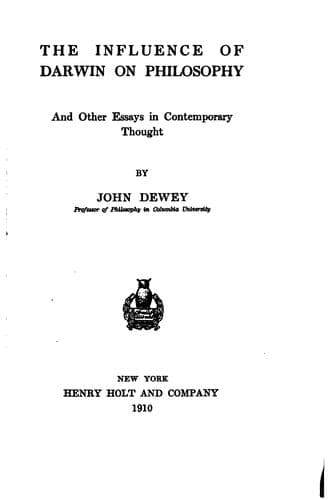
The Influence of Darwin on Philosophy, and other essays in contemporary thoughtDewey, John
Philosophy
The Influence of Darwin on Philosophy, and other essays in contemporary thought
Dewey, John
Evolution; Philosophy; Pragmatism
Moreover, such reflective thought as does intervene in the formation
and maintenance of these practical organizations harks back to prior
practical organizations, biological and social in nature. It serves
to _valuate_ organizations already existent as biological functions
and instincts, while, as itself a biological activity, it redirects
them to new conditions and results. Recognize, for example, that a
geometric concept is a practical locomotor function of arranging
stimuli in reference to maintenance of life activities _brought into
consciousness_, and then serving as a center of reorganization of
such activities to freer, more varied flexible and valuable forms;
recognize this, and we have the truth of the Kantian idea, without
its excrescences and miracles. The concept is the practical activity
doing consciously and artfully what it had aforetime done blindly and
aimlessly, and thereby not only doing it better but opening up a freer
world of significant activities. Thought as such a reorganization
of natural functions does naturally what Kantian forms and
schematizations do only supernaturally. In a word, the constructive
or organizing activity of “thought” does not inhere in thought as a
transcendental function, a form or mode of some supra-empirical ego,
mind, or consciousness, but in thought as itself vital activity. And
in any case we have passed to the idea of thought as reflectively
reconstructive and directive, and away from the notion of thought as
immanently constitutional and organizational. To make this passage
and yet to ignore its existence and import is essential to objective
idealism.
(2) No final or ultimate validity attaches to these original
arrangements and institutionalizations in any case. Their value is
teleological and experimental, not fixedly ontological. “Law and
order” are good things, but not when they become rigidity, and create
mechanical uniformity or routine. Prejudice is the acme of the _a
priori_. Of the _a priori_ in this sense we may say what is always
to be said of habits and institutions: They are good servants, but
harsh and futile masters. Organization as already effected is always
in danger of becoming a _mortmain_; it may be a way of sacrificing
novelty, flexibility, freedom, creation to static standards. The
curious inefficiency of idealism at this point is evident in the fact
that genuine thought, empirical reflective thought, is required
precisely for the purpose of re-forming established and set formations.
Public-domain text, read in full here on John Shaqi.
Reviews
Reviews
No reviews yet
Be the first to share your thoughts on this work.
Elsewhere in the archive
Join the Discussion
Join the discussion
Sign in to leave a comment or review.
Sign InorCreate an account