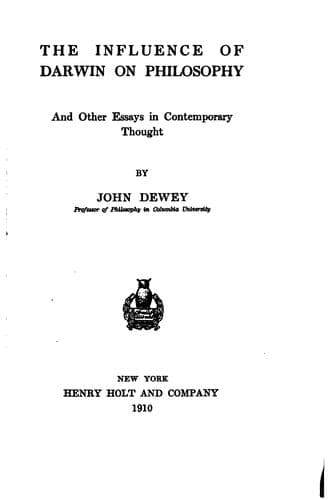
The Influence of Darwin on Philosophy, and other essays in contemporary thoughtDewey, John
Philosophy
The Influence of Darwin on Philosophy, and other essays in contemporary thought
Dewey, John
Evolution; Philosophy; Pragmatism
So far as Locke ignored this instrumental character of observation, he
naturally evoked and strengthened rationalistic idealism; he called
forth its assertion of the need of reason, of concepts, of universals,
to constitute knowledge in its eulogistic sense. But two contrary
errors do not make a truth, although they suggest and determine the
nature of some relevant truth. This truth is the empirical origin, in
a determinate type of situation, of the contrast of observation and
conception; the empirical relevancy and the empirical worth of this
contrast in controlling the character of subsequent experiences. To
suppose that perception as it concretely exists, either in the early
experiences of the animal, the race, or the individual, or in its
later refined and expanded experiences, is identical with the sharply
analyzed, objectively discriminated and internally disintegrated
elements of scientific observation, is a perversion of experience; a
perversion for which, indeed, professed empiricists set the example,
but which idealism must perpetuate if it is not to find its end in an
improved, functional empiricism.[41]
IV
We come now to the consideration of the third element in our problem;
ideality, important and normative value, in relation to experience;
the antithesis of experience as a tentative, fragmentary, and
ineffectual embodiment of meaning over against the perfect, eternal
system of meanings which experience suggests even in nullifying and
mutilating.
That from the _memory_ standpoint experience presents itself as a
multiplicity of episodic events with just enough continuity among
them to suggest principles true “on the whole” or usually, but
without furnishing instruction as to their exact range and bearing,
seems obvious enough. Why should it not? The motive which leads to
reflection on _past_ experience could be satisfied in no other way.
Continuities, connecting links, dynamic transitions drop out because,
for the purpose of the recollection, they would be hindrances if now
repeated; or because they are now available only when themselves
objectified in definite terms and thus given a _quasi_ independent, a
_quasi_ atomistic standing of their own. This is the only alternative
to what the psychologists term “total reminiscence,” which, so far
as total, leave us with an elephant on our hands. Unless we are
going to have a wholesale revivification of the past, giving us just
another embarrassing present experience, illusory because irrelevant,
memory must work by retail--by summoning _distinct_ cases, events,
sequences, precedents. Dis-membering is a positively necessary part
of re-membering. But the resulting _disjecta membra_ are in no sense
experience as it was or is; they are simply elements held apart, and
yet tentatively implicated together, in present experience for the
sake of its most favorable evolution; evolution in the direction of
the most excellent meaning or value conceived. If the remembering is
Public-domain text, read in full here on John Shaqi.
Reviews
Reviews
No reviews yet
Be the first to share your thoughts on this work.
Elsewhere in the archive
Join the Discussion
Join the discussion
Sign in to leave a comment or review.
Sign InorCreate an account