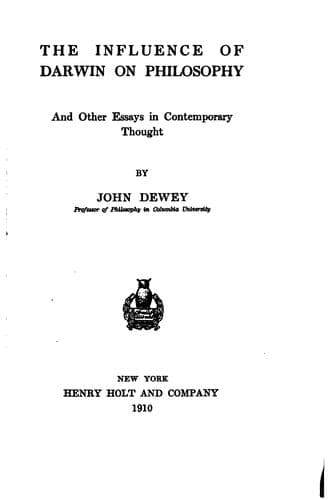
The Influence of Darwin on Philosophy, and other essays in contemporary thoughtDewey, John
Philosophy
The Influence of Darwin on Philosophy, and other essays in contemporary thought
Dewey, John
Evolution; Philosophy; Pragmatism
efficacious and pertinent, it reveals the possibilities of the present;
that is to say, it clarifies the transitive, transforming character
that belongs inherently to the present. The dismembering of the vital
present into the disconnected past is correlative to an anticipation,
an idealization of the future.
Moreover, the contingent character of the principle or rule that
emerges from a survey of cases, instances, as distinct from a fixed or
necessary character, secures just what is wanted in the exigency of
a prospective idealization, or refinement of excellence. It is just
this character that secures flexibility and variety of outlook, that
makes possible a consideration of alternatives and an attempt to select
and to execute the more worthy among them. The fixed or necessary law
would mean a future like the past--a dead, an unidealized future. It
is exasperating to imagine how completely different would have been
Aristotle’s valuation of “experience” with respect to its contingency,
if he had but once employed the function of developing and perfecting
value, instead of the function of knowing an unalterable object, as the
standard by which to estimate and measure intelligence.
The one constant trait of experience from its crudest to its most
mature forms is that its contents undergo change of meaning, and
of meaning in the sense of excellence, value. Every experience
is in-course,[42] in course of becoming worse or better as to
its contents, or in course of conscious endeavor to sustain some
satisfactory level of value against encroachment or lapse. In this
effort, both precedent, the reduction of the present idealization,
the anticipation of the possible, though doubtful, future, emerge.
Without idealization, that is, without conception of the favorable
issue that the present, defined in terms of precedents, may portend in
its transition, the recollection of precedents, and the formulation
of tentative rules is nonsense. But without the identification of
the present in terms of elements suggested by the past, without
recognition, the ideal, the value projected as end, remains inert,
helpless, sentimental, without means of realization. Resembling cases
and anticipation, memory and idealization, are the corresponding terms
in which a present experience has its transitive force analyzed into
reciprocally pertinent means and ends.
Public-domain text, read in full here on John Shaqi.
Reviews
Reviews
No reviews yet
Be the first to share your thoughts on this work.
Elsewhere in the archive
Join the Discussion
Join the discussion
Sign in to leave a comment or review.
Sign InorCreate an account