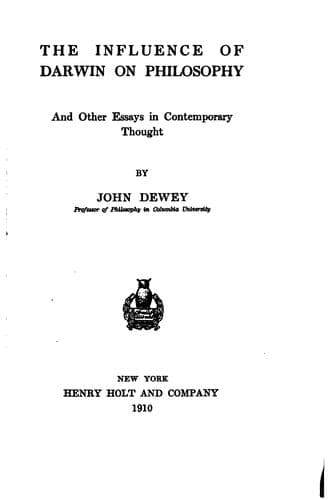
The Influence of Darwin on Philosophy, and other essays in contemporary thoughtDewey, John
Philosophy
The Influence of Darwin on Philosophy, and other essays in contemporary thought
Dewey, John
Evolution; Philosophy; Pragmatism
Now, this statement that things are what they are experienced to be
is usually translated into the statement that things (or, ultimately,
Reality, Being) _are_ only and just what they are _known_ to be or that
things are, or Reality _is_, what it is for a conscious knower--whether
the knower be conceived primarily as a perceiver or as a thinker
being a further, and secondary, question. This is the root-paralogism
of all idealisms, whether subjective or objective, psychological
or epistemological. By our postulate, things are what they are
experienced to be; and, unless knowing is the sole and only genuine
mode of experiencing, it is fallacious to say that Reality is just and
exclusively what it is or would be to an all-competent all-knower; or
even that it _is_, relatively and piecemeal, what it is to a finite
and partial knower. Or, put more positively, knowing is one mode of
experiencing, and the primary philosophic demand (from the standpoint
of immediatism) is to find out _what_ sort of an experience knowing
is--or, concretely how things are experienced when they are experienced
_as_ known things.[46] By concretely is meant, obviously enough
(among other things), such an account of the experience of things as
known that will bring out the characteristic traits and distinctions
they possess as things of a knowing experience, as compared with
things experienced esthetically, or morally, or economically, or
technologically. To assume that, because from the _standpoint of
the knowledge experience_ things _are_ what they are known to be,
therefore, metaphysically, absolutely, without qualification,
everything in its reality (as distinct from its “appearance,” or
phenomenal occurrence) is what a knower would find it to be, is, from
the immediatist’s standpoint, if not the root of all philosophic evil,
at least one of its main roots. For this leaves out of account what
the knowledge standpoint is itself _experienced as_.
Public-domain text, read in full here on John Shaqi.
Reviews
Reviews
No reviews yet
Be the first to share your thoughts on this work.
Elsewhere in the archive
Join the Discussion
Join the discussion
Sign in to leave a comment or review.
Sign InorCreate an account