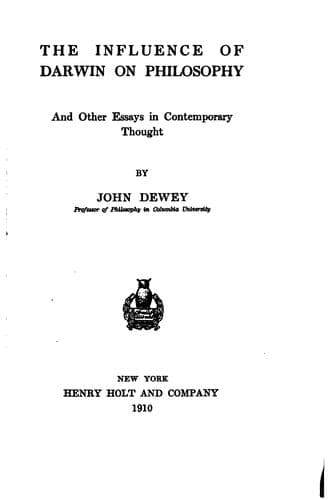
The Influence of Darwin on Philosophy, and other essays in contemporary thoughtDewey, John
Philosophy
The Influence of Darwin on Philosophy, and other essays in contemporary thought
Dewey, John
Evolution; Philosophy; Pragmatism
The criticisms made upon that vital but still unformed movement
variously termed radical empiricism, pragmatism, humanism,
functionalism, according as one or another aspect of it is uppermost,
have left me with a conviction that the _fundamental_ difference is
not so much in matters overtly discussed as in a presupposition that
remains tacit: a presupposition as to what experience is and means. To
do my little part in clearing up the confusion, I shall try to make
my own presupposition explicit. The object of this paper is, then, to
set forth what I understand to be the postulate and the criterion of
_immediate empiricism_.[45]
Immediate empiricism postulates that things--anything, everything, in
the ordinary or non-technical use of the term “thing”--are what they
are experienced as. Hence, if one wishes to describe anything truly,
his task is to tell what it is experienced as being. If it is a horse
that is to be described, or the _equus_ that is to be defined, then
must the horse-trader, or the jockey, or the timid family man who
wants a “safe driver,” or the zoologist or the paleontologist tell us
what the horse is which is experienced. If these accounts turn out
different in some respects, as well as congruous in others, this is
no reason for assuming the content of one to be exclusively “real,”
and that of others to be “phenomenal”; for each account of what is
experienced will manifest that it is the account _of_ the horse-dealer,
or _of_ the zoologist, and hence will give the conditions requisite
for understanding the differences as well as the agreements of the
various accounts. And the principle varies not a whit if we bring in
the psychologist’s horse, the logician’s horse, or the metaphysician’s
horse.
In each case, the nub of the question is, _what sort of experience_ is
denoted or indicated: a concrete and determinate experience, varying,
when it varies, in specific real elements, and agreeing, when it
agrees, in specific real elements, so that we have a contrast, not
between _a_ Reality, and various approximations to, or phenomenal
representations of Reality, but between different reals of experience.
And the reader is begged to bear in mind that from this standpoint,
when “an experience” or “some sort of experience” is referred to, “some
thing” or “some sort of thing” is always meant.
Public-domain text, read in full here on John Shaqi.
Reviews
Reviews
No reviews yet
Be the first to share your thoughts on this work.
Elsewhere in the archive
Join the Discussion
Join the discussion
Sign in to leave a comment or review.
Sign InorCreate an account