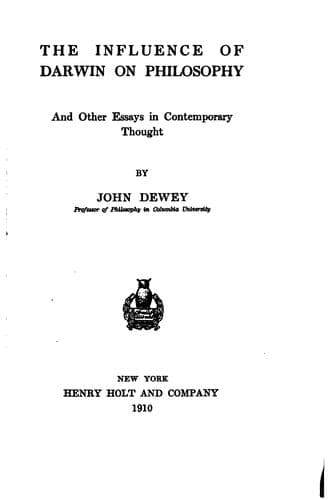
The Influence of Darwin on Philosophy, and other essays in contemporary thoughtDewey, John
Philosophy
The Influence of Darwin on Philosophy, and other essays in contemporary thought
Dewey, John
Evolution; Philosophy; Pragmatism
because the “really” is something not concretely experienced (whose
nature accordingly is the critic’s business); and this is to depart
from the empiricist’s point of view, to attribute to him a postulate he
expressly repudiates.
The material point may come out more clearly if I say that we must
make a distinction between a thing as _cognitive_, and one as
_cognized_.[50] I should define a cognitive experience as one that has
certain bearings or implications which induce, and fulfil themselves
in, a subsequent experience in which the relevant thing is experienced
_as_ cognized, _as_ a known object, and is thereby transformed, or
reorganized. The fright-at-the-noise in the case cited is obviously
_cognitive_, in this sense. By description, it induces an investigation
or inquiry in which both noise and fright are objectively stated or
presented--the noise as a shade-wind fact, the fright as an organic
reaction to a sudden acoustic stimulus, a reaction that under the
given circumstances was useless or even detrimental, a maladaptation.
Now, pretty much all of experience is of this sort (the “is” meaning,
of course, is experienced _as_), and the empiricist is false to his
principle if he does not duly note this fact.[51] But he is equally
false to his principle if he permits himself to be confused as to the
concrete differences in the two things experienced.
There are two little words through explication of which the
empiricist’s position may be brought out--“_as_” and “_that_.” We may
express his presupposition by saying that things are what they are
experienced _as_ being; or that to give a just account of anything
is to tell what _that_ thing is experienced to be. By these words I
want to indicate the absolute, final, irreducible, and inexpugnable
concrete _quale_ which everything experienced not so much _has_ as
_is_. To grasp this aspect of empiricism is to see what the empiricist
means by objectivity, by the element of control. Suppose we take,
as a crucial case for the empiricist, an out and out illusion, say
of Zöllner’s lines. These are experienced as convergent; they are
“truly” parallel. If things are what they are experienced as being,
how can the distinction be drawn between illusion and the true state
of the case? There is no answer to this question except by sticking
to the fact that the experience of the lines as divergent is a
concrete qualitative thing or _that_. It is _that_ experience which
it is, and no other. And if the reader rebels at the iteration of
such obvious tautology, I can only reiterate that the realization of
the _meaning_ of this tautology is the key to the whole question of
the objectivity of experience, as that stands to the empiricist. The
lines of _that_ experience _are_ divergent; not merely _seem_ so. The
question of truth is not as to whether Being or Non-Being, Reality or
mere Appearance, is experienced, but as to the _worth_ of a certain
concretely experienced thing. The only way of passing upon this
Public-domain text, read in full here on John Shaqi.
Reviews
Reviews
No reviews yet
Be the first to share your thoughts on this work.
Elsewhere in the archive
Join the Discussion
Join the discussion
Sign in to leave a comment or review.
Sign InorCreate an account