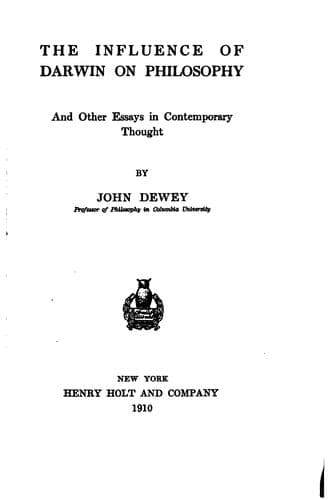
The Influence of Darwin on Philosophy, and other essays in contemporary thoughtDewey, John
Philosophy
The Influence of Darwin on Philosophy, and other essays in contemporary thought
Dewey, John
Evolution; Philosophy; Pragmatism
question is by sticking in the most uncompromising fashion to _that_
experience as real. _That_ experience is that two lines with certain
cross-hatchings are apprehended as convergent; only by taking that
experience as real and as fully real, is there any basis for, or way of
going to, an experienced knowledge that the lines are parallel. It is
in the concrete thing _as experienced_ that all the grounds and clues
to its own intellectual or logical rectification are contained. It is
because this thing, afterwards adjudged false, is a concrete _that_,
that it develops into a corrected experience (that is, experience of a
corrected thing--we reform things just as we reform ourselves or a bad
boy) whose full content is not a whit more real, but which is true or
truer.[52]
If _any_ experience, then a _determinate_ experience; and this
determinateness is the only, and is the adequate, principle of
control, or “objectivity.” The experience may be of the vaguest sort.
I may not see anything which I can identify as a familiar object--a
table, a chair, etc. It may be dark; I may have only the vaguest
impression that there is something which looks like a table. Or I may
be completely befogged and confused, as when one rises quickly from
sleep in a pitch-dark room. But this vagueness, this doubtfulness,
this confusion is the thing experienced, and, _qua_ real, is as “good”
a reality as the self-luminous vision of an Absolute. It is not just
vagueness, doubtfulness, confusion, at large or in general. It is
_this_ vagueness, and no other; absolutely unique, absolutely what
_it_ is.[53] Whatever gain in clearness, in fullness, in trueness of
content is experienced must grow out of some element in the experience
of _this_ experienced _as_ what it is. To return to the illusion: If
the experience of the lines as convergent is illusory, it is because of
some elements in the thing as experienced, not because of something
defined in terms of externality to this particular experience. If the
illusoriness can be detected, it is because the thing experienced
is real, having within its experienced reality elements whose _own
mutual_ tension effects its reconstruction. Taken concretely, the
experience of convergent lines contains within itself the elements
of the transformation of its own content. It is _this_ thing, and
not some separate truth, that clamors for its own reform. There is,
then, from the empiricist’s point of view, no need to search for some
aboriginal _that_ to which all successive experiences are attached,
and which is somehow thereby undergoing continuous change. Experience
is always of _thats_; and the most comprehensive and inclusive
experience of the universe that the philosopher himself can obtain
is the experience of a characteristic _that_. From the empiricist’s
point of view, this is as true of the exhaustive and complete insight
of a hypothetical all-knower as of the vague, blind experience of the
awakened sleeper.
Public-domain text, read in full here on John Shaqi.
Reviews
Reviews
No reviews yet
Be the first to share your thoughts on this work.
Elsewhere in the archive
Join the Discussion
Join the discussion
Sign in to leave a comment or review.
Sign InorCreate an account