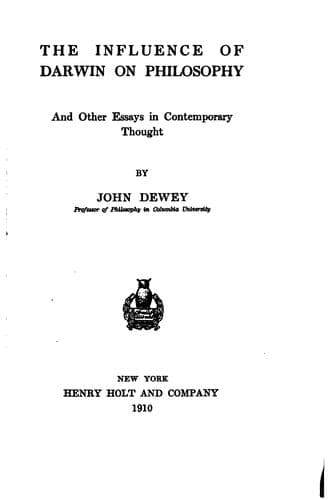
The Influence of Darwin on Philosophy, and other essays in contemporary thoughtDewey, John
Philosophy
The Influence of Darwin on Philosophy, and other essays in contemporary thought
Dewey, John
Evolution; Philosophy; Pragmatism
As reals, they stand on the same level. As trues,
the latter has by definition the better of it; but if this insight is
in any way the truth of the blind awakening, it is because the latter
has, in its _own_ determinate _quale_, elements of real continuity
with the former; it is, _ex hypothesi_, transformable through a series
of experienced reals without break of continuity, into the absolute
thought-experience. There is no need of logical manipulation to effect
the transformation, nor _could_ any logical consideration effect it.
If effected at all it is just by immediate experiences, each of which
is just as real (no more, no less) as either of the two terms between
which they lie. Such, at least, is the meaning of the empiricist’s
contention. So, when he talks of experience, he does not mean some
grandiose, remote affair that is cast like a net around a succession
of fleeting experiences; he does not mean an indefinite total,
comprehensive experience which somehow engirdles an endless flux; he
means that _things_ are what they are experienced to be, and that every
experience is _some_ thing.
From the postulate of empiricism, then (or, what is the same thing,
from a _general_ consideration of the concept of experience), nothing
can be deduced, not a single philosophical proposition.[54] The
reader may hence conclude that all this just comes to the truism that
experience is experience, or is what it is. If one attempts to draw
conclusions from the bare concept of experience, the reader is quite
right. But the real significance of the principle is that of a method
of philosophical analysis--a method identical in kind (but differing
in problem and hence in operation) with that of the scientist. If you
wish to find out what subjective, objective, physical, mental, cosmic,
psychic, cause, substance, purpose, activity, evil, being, quality--any
philosophic term, in short--means, go to experience and see what the
thing is experienced _as_.
Such a method is not spectacular; it permits of no offhand
demonstrations of God, freedom, immortality, nor of the exclusive
reality of matter, or ideas, or consciousness, etc. But it supplies a
way of telling what all these terms mean. It may seem insignificant,
or chillingly disappointing, but only upon condition that it be not
worked. Philosophic conceptions have, I believe, outlived their
usefulness considered as stimulants to emotion, or as a species of
sanctions; and a larger, more fruitful and more valuable career awaits
them considered as specifically experienced meanings.
Public-domain text, read in full here on John Shaqi.
Reviews
Reviews
No reviews yet
Be the first to share your thoughts on this work.
Elsewhere in the archive
Join the Discussion
Join the discussion
Sign in to leave a comment or review.
Sign InorCreate an account