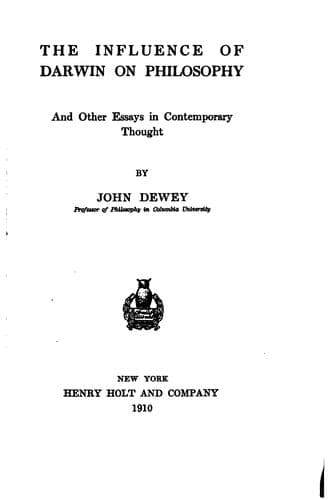
The Influence of Darwin on Philosophy, and other essays in contemporary thoughtDewey, John
Philosophy
The Influence of Darwin on Philosophy, and other essays in contemporary thought
Dewey, John
Evolution; Philosophy; Pragmatism
Finally, there is nothing in the text that denies the existence
of things temporally prior to human experiencing of them.
Indeed, I should think it fairly obvious that we experience most
things _as_ temporally prior to our experiencing of them. The
import of the article is to the effect that we are not entitled
to draw philosophic (as distinct from scientific) conclusions
as to the meaning of prior temporal existence till we have
ascertained what it is to experience a thing as past. These four
disclaimers cover, I think, all the misapprehensions disclosed in
the four or five controversial articles (noted below) that the
original essay evoked. One of these articles (that of Professor
Woodbridge), raised a point of fact, holding that cognitional
experience tells us, without alteration, just what the things
of other types of experience are, and in that sense transcends
other experiences. This is too fundamental an issue to discuss
in a note, and I content myself with remarking that with respect
to it, the bearing of the article is that the issue must be
settled by a careful descriptive survey of things as experienced,
to see whether modifications do not occur in existences when
they are experienced _as_ known; _i.e._, as true or false in
character. The reader interested in following up this discussion
is referred to the following articles: Vol. II. of the _Journal
of Philosophy, Psychology, and Scientific Methods_, two articles
by Bakewell, p. 520 and p. 687; one by Bode, p. 658; one by
Woodbridge, p. 573; Vol. III. of the same Journal, by Leighton,
p. 174.]
“CONSCIOUSNESS” AND EXPERIENCE[55]
Every science in its final standpoint and working aims is controlled
by conditions lying outside itself--conditions that subsist in the
practical life of the time. With no science is this as obviously true
as with psychology. Taken without nicety of analysis, no one would
deny that psychology is specially occupied with the individual; that
it wishes to find out those things that proceed peculiarly from the
individual, and the mode of their connection with him. Now, the way
in which the individual is conceived, the value that is attributed to
him, the things in his make-up that arouse interest, are not due at the
outset to psychology. The scientific view regards these matters in a
reflected, a borrowed, medium. They are revealed in the light of social
life. An autocratic, an aristocratic, a democratic society propound
such different estimates of the worth and place of individuality;
they procure for the individual as an individual such different sorts
of experience; they aim at arousing such different impulses and
at organizing them according to such different purposes, that the
psychology arising in each must show a different temper.
Public-domain text, read in full here on John Shaqi.
Reviews
Reviews
No reviews yet
Be the first to share your thoughts on this work.
Elsewhere in the archive
Join the Discussion
Join the discussion
Sign in to leave a comment or review.
Sign InorCreate an account