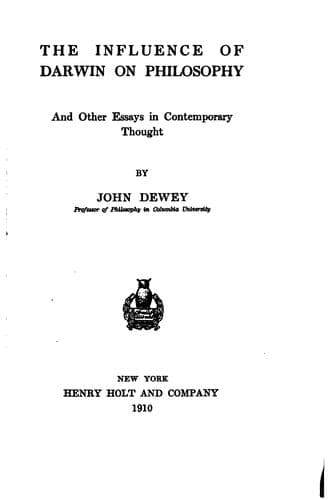
The Influence of Darwin on Philosophy, and other essays in contemporary thoughtDewey, John
Philosophy
The Influence of Darwin on Philosophy, and other essays in contemporary thought
Dewey, John
Evolution; Philosophy; Pragmatism
In this sense, psychology is a political science. While the professed
psychologist, in his conscious procedure, may easily cut his
subject-matter loose from these practical ties and references, yet the
starting point and goal of his course are none the less socially set.
In this conviction I venture to introduce to an audience that could
hardly be expected to be interested in the technique of psychology, a
technical subject, hoping that the human meaning may yet appear.
There is at present a strong, apparently a growing tendency to conceive
of psychology as an account of the consciousness of the individual,
considered as something in and by itself; consciousness, the assumption
virtually runs, being of such an order that it may be analyzed,
described, and explained in terms of just itself. The statement, as
commonly made, is that psychology is an account of consciousness, _qua_
consciousness; and the phrase is supposed to limit psychology to a
certain definite sphere of fact that may receive adequate discussion
for scientific purposes, without troubling itself with what lies
outside. Now if this conception be true, there is no intimate, no
important connection of psychology and philosophy at large. That
philosophy, whose range is comprehensive, whose problems are catholic,
should be held down by a discipline whose voice is as partial as its
material is limited, is out of the range of intelligent discussion.
But there is another possibility. If the individual of whom psychology
treats be, after all, a social individual, any absolute setting off and
apart of a sphere of consciousness as, even for scientific purposes,
self-sufficient, is condemned in advance. All such limitation, and
all inquiries, descriptions, explanations that go with it, are only
preliminary. “Consciousness” is but a symbol, an anatomy whose life is
in natural and social operations. To know the symbol, the psychical
letter, is important; but its necessity lies not within itself, but
in the need of a language for reading the things signified. If this
view be correct, we cannot be so sure that psychology is without large
philosophic significance. Whatever meaning the individual has for the
social life that he both incorporates and animates, that meaning has
psychology for philosophy.
Public-domain text, read in full here on John Shaqi.
Reviews
Reviews
No reviews yet
Be the first to share your thoughts on this work.
Elsewhere in the archive
Join the Discussion
Join the discussion
Sign in to leave a comment or review.
Sign InorCreate an account