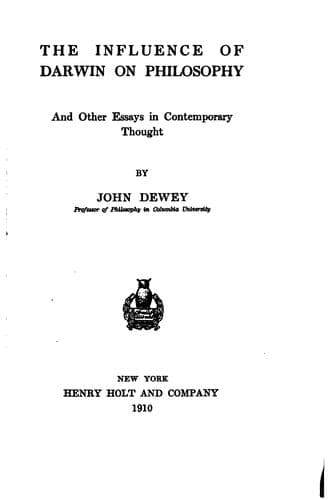
The Influence of Darwin on Philosophy, and other essays in contemporary thoughtDewey, John
Philosophy
The Influence of Darwin on Philosophy, and other essays in contemporary thought
Dewey, John
Evolution; Philosophy; Pragmatism
not altogether oblivious, in her modesty, of a possible future check to
the pride of her haughty sister, and of a certain coronation that shall
mark her coming to her own.
But, be the reasons as they may, there is little doubt of the fact.
Almost all our working psychologists admit, nay, herald this limitation
of their work. I am not presumptuous enough to set myself against this
array. I too proclaim myself of those who believe that psychology has
to do (at a certain point, that is) with “consciousness as such.” But
I do not believe that the limitation is final. Quite the contrary:
if “consciousness” or “state of consciousness” be given intelligible
meaning, I believe that this conception is the open gateway into the
fair fields of philosophy. For, note you, the phrase is an ambiguous
one. It may mean one thing to the metaphysician who proclaims: Here
finally we have psychology recognizing her due metes and bounds,
giving bonds to trespass no more. It may mean quite another thing to
the psychologist in his work--whatever he may happen to say about it.
It may be that the psychologist deals with states of consciousness
as the significant, the analyzable and describable form, to which he
reduces the things he is studying. Not that they _are_ that existence,
but that they are its indications, its clues, in shape for handling
by scientific methods. So, for example, does the paleontologist
work. Those curiously shaped and marked forms to which he is devoted
are not life, nor are they the literal termini of his endeavor; but
through them as signs and records he construes a life. And again, the
painter-artist might well say that he is concerned only with colored
paints as such. Yet none the less through them as registers and
indices, he reveals to us the mysteries of sunny meadow, shady forest,
and twilight wave. These are the things-in-themselves of which the oils
on his palette are phenomena.
Public-domain text, read in full here on John Shaqi.
Reviews
Reviews
No reviews yet
Be the first to share your thoughts on this work.
Elsewhere in the archive
Join the Discussion
Join the discussion
Sign in to leave a comment or review.
Sign InorCreate an account