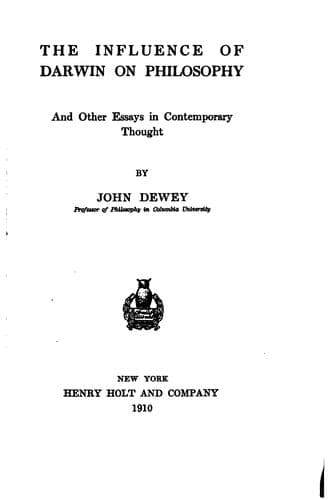
The Influence of Darwin on Philosophy, and other essays in contemporary thoughtDewey, John
Philosophy
The Influence of Darwin on Philosophy, and other essays in contemporary thought
Dewey, John
Evolution; Philosophy; Pragmatism
This problem is too important and too large to suffer attack in
an evening’s address. Yet I venture to consider a portion of it,
hoping that such things as appear will be useful clues in entering
wider territory. We may ask what is the effect upon psychology of
considering its material as something so distinct as to be capable
of treatment without involving larger issues. In this inquiry we
take as representative some such account of the science as this:
Psychology deals with consciousness “as such” in its various modes and
processes. It aims at an isolation of each such as will permit accurate
description: at statement of its place in the serial order such as will
enable us to state the laws by which one calls another into being,
or as will give the natural history of its origin, maturing, and
dissolution. It is both analytic and synthetic--analytic in that it
resolves each state into its constituent elements; synthetic in that it
discovers the processes by which these elements combine into complex
wholes and series. It leaves alone--it shuts out--questions concerning
the validity, the objective import of these modifications: of their
value in conveying truth, in effecting goodness, in constituting
beauty. For it is just with such questions of worth, of validity, that
philosophy has to do.
Some such view as this is held by the great majority of working
psychologists to-day. A variety of reasons have conspired to bring
about general acceptance. Such a view seems to enroll one in the ranks
of the scientific men rather than of the metaphysicians--and there are
those who distrust the metaphysicians. Others desire to take problems
piecemeal and in detail, avoiding that excursion into ultimates, into
that never-ending panorama of new questions and new possibilities
that seems to be the fate of the philosopher. While no temperate
mind can do other than sympathize with this view, it is hardly more
than an expedient. For, as Mr. James remarks, after disposing of
the question of free-will by relegating it to the domain of the
metaphysician:--“Metaphysics means only an unusually obstinate attempt
to think clearly and consistently”--and clearness and consistency are
not things to be put off beyond a certain point. When the metaphysician
chimes in with this new-found modesty of the psychologist, so different
from the disposition of Locke and Hume and the Mills, salving his
metaphysical conscience with the remark--it hardly possesses the
dignity of a conviction--that the partial sciences, just because they
are partial, are not expected to be coherent with themselves nor with
one another; when the metaphysician, I say, praises the psychologist
for sticking to his last, we are reminded that another motive is
also at work. There is a half-conscious irony in this abnegation of
psychology. It is not the first time that science has assumed the work
of Cinderella; and, since Mr. Huxley has happily reminded her, she is
Public-domain text, read in full here on John Shaqi.
Reviews
Reviews
No reviews yet
Be the first to share your thoughts on this work.
Elsewhere in the archive
Join the Discussion
Join the discussion
Sign in to leave a comment or review.
Sign InorCreate an account