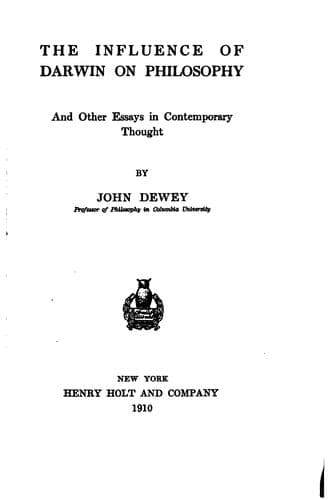
The Influence of Darwin on Philosophy, and other essays in contemporary thoughtDewey, John
Philosophy
The Influence of Darwin on Philosophy, and other essays in contemporary thought
Dewey, John
Evolution; Philosophy; Pragmatism
Undoubtedly we are between two fires. In placing upon psychology
the responsibility of discovering the method of experience, as a
sequence of acts and passions, do we not destroy just that limitation
to concrete detail which now constitutes it a science? Will not the
psychologist be the first to repudiate this attempt to mix him up
in matters philosophical? We need only to keep in mind the specific
facts involved in the term Course or Process of Experience to avoid
this danger. The immediate preoccupation of the psychologist is with
very definite and empirical facts--questions like the limits of
audition, of the origin of pitch, of the structure and conditions of
the musical scale, etc. Just so the immediate affair of the geologist
is with particular rock-structures, of the botanist with particular
plants, and so on. But through the collection, description, location,
classification of rocks the geologist is led to the splendid story
of world-forming. The limited, fixed, and separate piece of work is
dissolved away in the fluent and dynamic drama of the earth. So, the
plant leads with inevitableness to the whole process of life and its
evolution.
In form, the botanist still studies the genus, the species, the
plant--hardly, indeed, that; rather the special parts, the structural
elements, of the plant. In reality, he studies life itself; the
structures are the indications, the signature through which he
renders transparent the mystery of life growing in the changing
world. It was doubtless necessary for the botanist to go through the
Linnean period--the period of engagement with rigid detail and fixed
classifications; of tearing apart and piecing together; of throwing
all emphasis upon peculiarities of number, size, and appearance of
matured structure; of regarding change, growth, and function as
external, more or less interesting, attachments to form. Examination
of this period is instructive; there is much in contemporary
investigation and discussion that is almost unpleasantly reminiscent in
its suggestiveness. The psychologist should profit by the intervening
history of science. The conception of evolution is not so much an
additional law as it is a face-about. The fixed structure, the separate
form, the isolated element, is henceforth at best a mere stepping-stone
to knowledge of process, and when not at its best, marks the end of
comprehension, and betokens failure to grasp the problem.
Public-domain text, read in full here on John Shaqi.
Reviews
Reviews
No reviews yet
Be the first to share your thoughts on this work.
Elsewhere in the archive
Join the Discussion
Join the discussion
Sign in to leave a comment or review.
Sign InorCreate an account