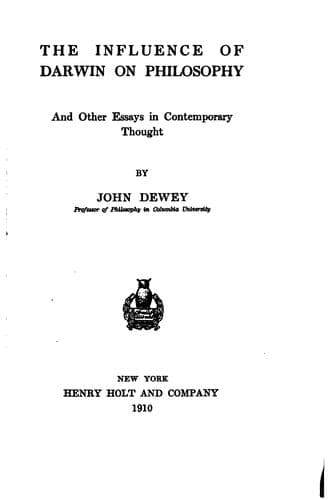
The Influence of Darwin on Philosophy, and other essays in contemporary thoughtDewey, John
Philosophy
The Influence of Darwin on Philosophy, and other essays in contemporary thought
Dewey, John
Evolution; Philosophy; Pragmatism
With the change in standpoint from self-included existence to including
process, from structural unit of composition to controlling unity
of function, from changeless form to movement in growth, the whole
scheme of values is transformed. Faculties are definite directions of
development; elements are products that are starting-points for new
processes; bare facts are indices of change; static conditions are
modes of accomplished adjustment. Not that the concrete, empirical
phenomenon loses in worth, much less that unverifiable “metaphysical”
entities are impertinently introduced; but that our aim is the
discovery of a process of actions in its adaptations to circumstance.
If we apply this evolutionary logic in psychology, where shall we
stop? Questions of limits of stimuli in a given sense, say hearing,
are in reality questions of temporary arrests, adjustments marking the
favorable equilibrium of the whole organism; they connect with the
question of the use of sensation in general and auditory sensations
in particular for life-habits; of the origin and use of localized and
distinguished perception; and this, in turn, involves within itself
the whole question of space and time recognition; the significance
of the thing-and-quality experience, and so on. And when we are told
that the question of the origin of space experience has nothing at all
to do with the question of the nature and significance of the space
experienced, the statement is simply evidence that the one who makes
it is still at the static standpoint; he believes that things, that
relations, have existence and significance apart from the particular
conditions under which they come into experience, and apart from the
special service rendered in those particular conditions.
Of course, I am far from saying that every psychologist must make the
whole journey. Each individual may contract, as he pleases, for any
section or subsection he prefers; and undoubtedly the well-being of
the science is advanced by such division of labor. But psychology
goes over the whole ground from detecting every distinct act of
experiencing, to seeing what need calls out the special organ fitted to
cope with the situation, and discovering the machinery through which it
operates to keep a-going the course of action.
Public-domain text, read in full here on John Shaqi.
Reviews
Reviews
No reviews yet
Be the first to share your thoughts on this work.
Elsewhere in the archive
Join the Discussion
Join the discussion
Sign in to leave a comment or review.
Sign InorCreate an account