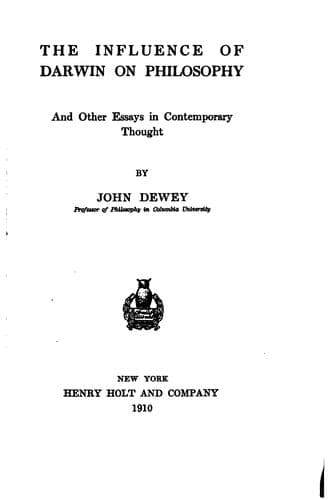
The Influence of Darwin on Philosophy, and other essays in contemporary thoughtDewey, John
Philosophy
The Influence of Darwin on Philosophy, and other essays in contemporary thought
Dewey, John
Evolution; Philosophy; Pragmatism
Some such assumption as this lies latent, I am convinced, in all
forswearings of the kinship of psychology and philosophy. Two
conceptions hang together. The opinion that psychology is an account
only and finally of states of consciousness, and therefore can throw
no light upon the objects with which philosophy deals, is twin to
the doctrine that the whole conscious life of the individual is not
organic to the world. The philosophic basis and scope of this doctrine
lie beyond examination here. But even in passing one cannot avoid
remarking that the doctrine is almost never consistently held; the
doctrine logically carried out leads so directly to intellectual and
moral scepticism that the theory usually prefers to work in the dark
background as a disposition and temper of thought rather than to make a
frank statement of itself. Even in the half-hearted expositions of the
process of human experience as something merely annexed to the reality
of the universe, we are brought face to face to the consideration with
which we set out: the dependence of theories of the individual upon
the position at a given time of the individual practical and social.
The doctrine of the accidental, futile, transitory significance of the
individual’s experience as compared with eternal realities; the notion
that at best the individual is simply realizing for and in himself
what already has fixed completeness in itself is congruous only with
a certain intellectual and political scheme and must modify itself as
that shifts. When such rearrangement comes, our estimate of the nature
and importance of psychology will mirror the change.
When man’s command of the methods that control action was precarious
and disturbed; when the tools that subject the world of things and
forces to use and operation were rare and clumsy, it was unavoidable
that the individual should submit his perception and purpose blankly to
the blank reality beyond. Under such circumstances, external authority
must reign; the belief that human experience in itself is approximate,
not intrinsic, is inevitable. Under such circumstances, reference to
the individual, to the subject, is a resort only for explaining error,
illusion, and uncertainty. The necessity of external control and
external redemption of experience reports itself in a low valuation of
the self, and of all the factors and phases of experience that spring
from the self. That the psychology of medievalism should appear only as
a portion of its theology of sin and salvation is as obvious as that
the psychology of the Greeks should be a chapter of cosmology.
As against all this, the assertion is ventured that psychology,
supplying us with knowledge of the behavior of experience, is a
conception of democracy. Its postulate is that since experience
fulfils itself in individuals, since it administers itself through
their instrumentality, the account of the course and method of this
achievement is a significant and indispensable affair.
Public-domain text, read in full here on John Shaqi.
Reviews
Reviews
No reviews yet
Be the first to share your thoughts on this work.
Elsewhere in the archive
Join the Discussion
Join the discussion
Sign in to leave a comment or review.
Sign InorCreate an account