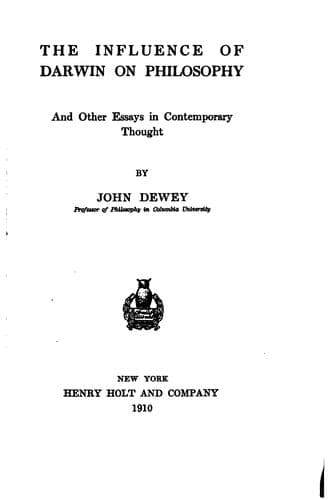
The Influence of Darwin on Philosophy, and other essays in contemporary thoughtDewey, John
Philosophy
The Influence of Darwin on Philosophy, and other essays in contemporary thought
Dewey, John
Evolution; Philosophy; Pragmatism
something of the temporal conditions under which a given value appears,
while its own eternal essential quality remains as opaque as before.
Nature knows no such divorce of quality and circumstance. Things come
when they are wanted and as they are wanted; their quality is precisely
the response they give to the conditions that call for them, while
the furtherance they afford to the movement of their whole is their
meaning. The severance of analysis and genesis, instead of serving as
a ready-made test by which to try out the empirical, temporal events
of psychology from the rational abiding constitution of philosophy,
is a brand of philosophic dualism: the supposition that values are
externally obtruded and statically set in irrelevant rubbish.
There are those who will admit that “states of consciousness” are
but the cross-sections of flow of behavior, arrested for inspection,
made in order that we may reconstruct experience in its lifehistory.
Yet in the knowledge of the course and method of our experience,
they will hold that we are far from the domain proper of philosophy.
Experience, they say, is just the historic achievement of finite
individuals; it tells the tale of approach to the treasures of truth,
of partial victory, but larger defeat, in laying hold of the treasure.
But, they say, reality is not the path to reality, and record of
devious wanderings in the path is hardly a safe account of the goal.
Psychology, in other words, may tell us something of how we mortals
lay hold of the world of things and truths; of how we appropriate
and assimilate its contents; and of how we react. It may trace the
issues of such approaches and apprehensions upon the course of our
own individual destinies. But it cannot wisely ignore nor sanely deny
the distinction between these individual strivings and achievements,
and the “Reality” that subsists and supports its own structure
outside these finite futilities. The processes by which we turn over
The Reality into terms of our fragmentary unconcluded, inconclusive
experiences are so extrinsic to the Reality itself as to have no
revealing power with reference to it. There is the _ordo ad universum_,
the subject of philosophy; there is the _ordo ad individuum_, the
subject of psychology.
Public-domain text, read in full here on John Shaqi.
Reviews
Reviews
No reviews yet
Be the first to share your thoughts on this work.
Elsewhere in the archive
Join the Discussion
Join the discussion
Sign in to leave a comment or review.
Sign InorCreate an account