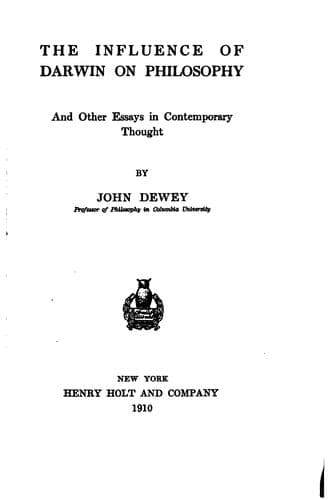
The Influence of Darwin on Philosophy, and other essays in contemporary thoughtDewey, John
Philosophy
The Influence of Darwin on Philosophy, and other essays in contemporary thought
Dewey, John
Evolution; Philosophy; Pragmatism
At the outset we take a long scope in our survey and present to
ourselves the epoch when philosophy was still consciously, and not
simply by implication, human, when reflective thought had not developed
its own technique of method, and was in no danger of being caught in
its own machinery--the time of Socrates. What does the assertion of
Socrates that an unexamined life is not one fit to be led by man; what
does his injunction “Know thyself” mean? It means that the corporate
motives and guarantees of conduct are breaking down. We have got away
from the time when the individual could both regulate and justify his
course of life by reference to the ideals incarnate in the habits of
the community of which he is a member. The time of direct and therefore
unconscious union with corporate life, finding therein stimuli, codes,
and values, has departed. The development of industry and commerce, of
war and politics, has brought face to face communities with different
aims and diverse habits; the development of myth and animism into crude
but genuine scientific observation and imagination has transformed
the physical widening of the horizon, brought about by commerce
and intercourse, into an intellectual and moral expansion. The old
supports fail precisely at the time when they are most needed--before
a widening and more complex scene of action. Where, then, shall the
agent of action turn? The “Know thyself” of Socrates is the reply to
the practical problem which confronted Athens in his day. Investigation
into the true ends and worths of human life, sifting and testing of all
competing ends, the discovery of a method which should validate the
genuine and dismiss the spurious, had henceforth to do for man what
consolidated and incorporate custom had hitherto presented as a free
and precious gift.
With Socrates the question is as direct and practical as the question
of making one’s living or of governing the state; it is indeed the
same question put in its general form. It is a question that the flute
player, the cobbler, and the politician must face no more and no less
than the reflective philosopher. The question is addressed by Socrates
to every individual and to every group with which he comes in contact.
Because the question is practical it is individual and direct. It is a
question which every one must face and answer for himself, just as in
the Protestant scheme every individual must face and solve for himself
the question of his final destiny.
Public-domain text, read in full here on John Shaqi.
Reviews
Reviews
No reviews yet
Be the first to share your thoughts on this work.
Elsewhere in the archive
Join the Discussion
Join the discussion
Sign in to leave a comment or review.
Sign InorCreate an account