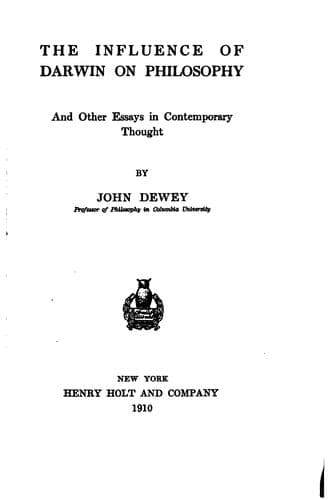
The Influence of Darwin on Philosophy, and other essays in contemporary thoughtDewey, John
Philosophy
The Influence of Darwin on Philosophy, and other essays in contemporary thought
Dewey, John
Evolution; Philosophy; Pragmatism
Yet the very attitude of Socrates carried with it the elements of its
own destruction. Socrates could only raise the question, or rather
demand of every individual that he raise it for himself. Of the answer
he declared himself to be as ignorant as was any one. The result
could be only a shifting of the center of interest. If the question is
so all-important, and yet the wisest of all men must confess that he
only knows his own ignorance as to its answer, the inevitable point
of further consideration is the discovery of a method which shall
enable the question to be answered. This is the significance of Plato.
The problem is the absolutely inevitable outgrowth of the Socratic
position; and yet it carried with it just as inevitably the separation
of philosopher from shoemaker and statesman, and the relegation of
theory to a position remote for the time being from conduct.
If the Socratic command, “Know thyself,” runs against the dead wall of
inability to conduct this knowledge, some one must take upon himself
the discovery of how the requisite knowledge may be obtained. A new
profession is born, that of the thinker. At this time the means,
the discovery of how the aims and worths of the self may be known
and measured, becomes, for this class, an end in itself. Theory is
ultimately to be applied to practice; but in the meantime the theory
must be worked out as theory or else no application. This represents
the peculiar equilibrium and the peculiar point of contradiction in
the Platonic system. All philosophy is simply for the sake of the
organization and regulation of social life; and yet the philosophers
must be a class by themselves, working out their peculiar problems
with their own particular tools.
With Aristotle the attempted balance failed. Social life is
disintegrating beyond the point of hope of a successful reorganization,
and thinking is becoming a fascinating pursuit for its own sake. The
world of practice is now the world of compromise and of adjustment.
It is relative to partial aims and finite agents. The sphere of
absolute and enduring truth and value can be reached only in and
through thought. The one who acts compromises himself with the animal
desire that inspires his action and with the alien material that forms
its stuff. In two short generations the divorce of philosophy from
life, the isolation of reflective theory from practical conduct, has
completed itself. So great is the irony of history that this sudden and
effective outcome was the result of the attempt to make thought the
instrument of action, and action the manifestation of truth reached by
thinking.
Public-domain text, read in full here on John Shaqi.
Reviews
Reviews
No reviews yet
Be the first to share your thoughts on this work.
Elsewhere in the archive
Join the Discussion
Join the discussion
Sign in to leave a comment or review.
Sign InorCreate an account