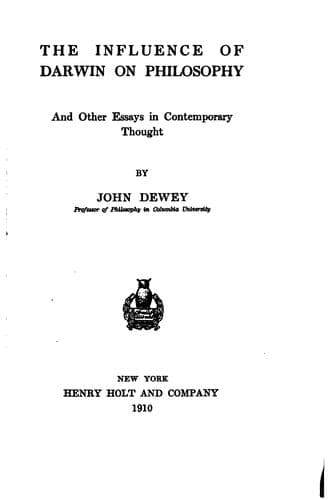
The Influence of Darwin on Philosophy, and other essays in contemporary thoughtDewey, John
Philosophy
The Influence of Darwin on Philosophy, and other essays in contemporary thought
Dewey, John
Evolution; Philosophy; Pragmatism
We have only a faint idea of how this was accomplished, or of the
thoroughness of the work done. We have perhaps even more inadequate
conceptions of the great organizing and centralizing work done by Greek
thought in the political sphere. When the military and administrative
genius of Rome brought the whole world in subjection to itself, the
most pressing of practical problems was to give unity of practical
aim and harmony of working machinery to the vast and confused
mass of local custom and tradition, religious, social, economic,
and intellectual, as well as political. In this juncture the great
administrators and lawyers of Rome seized with avidity upon the
results of the intellectual analysis of social and political relations
elaborated in Greek philosophy. Caring naught for these results in
their reflective and theoretical character, they saw in them the
possible instrument of introducing order into chaos and of transforming
the confused and conflicting medley of practice and opinion into a
harmonious social structure. Roman law, that formed the vertebral
column of civilization for a thousand years, and which articulated the
outer order of life as distinctly as Christianity controlled the inner,
was the outcome.
Thought was once more in unity with action, philosophy had become the
instrument of conduct. Mr. Bosanquet makes the pregnant remark “that
the weakness of medieval science and philosophy are connected rather
with excess of practice than with excess of theory. The subordination
of philosophy to theology is a subordination of science to a formulated
conception of human welfare. Its essence is present, not wherever there
is metaphysics but wherever the spirit of truth is subordinated to any
preconceived practical intent.” (“History of Esthetics,” p. 146.)
Once more the irony of history displays itself. Thought has become
practical, it has become the regulator of individual conduct and
social organization, but at the expense of its own freedom and power.
The defining characteristic of medievalism in state and in church, in
political and spiritual life, is that truth presents itself to the
individual only through the medium of organized authority.
Public-domain text, read in full here on John Shaqi.
Reviews
Reviews
No reviews yet
Be the first to share your thoughts on this work.
Elsewhere in the archive
Join the Discussion
Join the discussion
Sign in to leave a comment or review.
Sign InorCreate an account