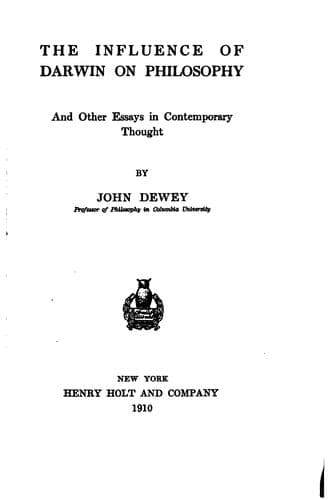
The Influence of Darwin on Philosophy, and other essays in contemporary thoughtDewey, John
Philosophy
The Influence of Darwin on Philosophy, and other essays in contemporary thought
Dewey, John
Evolution; Philosophy; Pragmatism
But this statement must not be taken too literally. It is impossible
that men should really separate their ideas from their acts. If we
look ahead a few centuries we find that the philosophy of Plato and
Aristotle has accomplished, in an indirect and unconscious way,
what perhaps it could never have effected by the more immediate and
practical method of Socrates. Philosophy became an organ of vision,
an instrument of interpretation; it furnished the medium through which
the world was seen and the course of life estimated. Philosophy died
as philosophy, to rise as the set and bent of the human mind. Through
a thousand and devious and roundabout channels, the thoughts of the
philosophers filtered through the strata of human consciousness and
conduct. Through the teachings of grammarians, rhetoricians, and a
variety of educational schools, they were spread in diluted form
through the whole Roman Empire and were again precipitated in the
common forms of speech. Through the earnestness of the moral propaganda
of the Stoics they became the working rules of life for the more
strenuous and earnest spirits. Through the speculations of the Sceptics
and Epicureans they became the chief reliance and consolation of a
large number of highly cultured individuals amid social turmoil and
political disintegration. All these influences and many more finally
summed themselves up in the two great media through which Greek
philosophy finally fixed the intellectual horizon of man, determined
the values of its perspective, and meted out the boundaries and
divisions of the scene of human action.
These two influences were the development of Christian theology
and moral theory, and the organization of the system of Roman
jurisprudence. There is perhaps no more fascinating chapter in
the history of humanity than the slow and tortuous processes by
which the ideas set in motion by that Athenian citizen who faced
death as serenely as he conversed with a friend, finally became the
intellectually organizing centers of the two great movements that
bridge the span between ancient civilization and modern. As the
personal and immediate force and enthusiasm of the movement initiated
by Jesus began to grow fainter and the commanding influence of his own
personality commenced to dim, the ideas of the world and of life, of
God and of man, elaborated in Greek philosophy, served to transform
moral enthusiasm and personal devotion to the redemption of humanity,
into a splendid and coherent view of the universe; a view that resisted
all disintegrating influences and gathered into itself the permanent
ideas and progressive ideals thus far developed in the history of man.
Public-domain text, read in full here on John Shaqi.
Reviews
Reviews
No reviews yet
Be the first to share your thoughts on this work.
Elsewhere in the archive
Join the Discussion
Join the discussion
Sign in to leave a comment or review.
Sign InorCreate an account