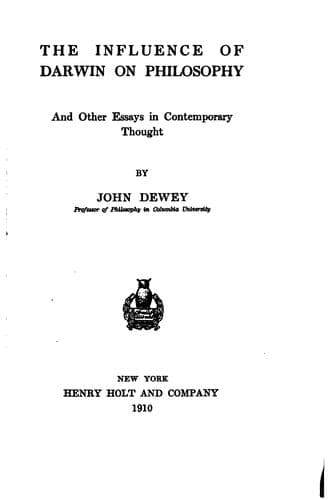
The Influence of Darwin on Philosophy, and other essays in contemporary thoughtDewey, John
Philosophy
The Influence of Darwin on Philosophy, and other essays in contemporary thought
Dewey, John
Evolution; Philosophy; Pragmatism
Pardon me these commonplaces, but they are necessary to the course of
the argument. By historic fallacy we often suppose, or imagine that
we suppose, that the individual had been present as a possible center
of action all through the Middle Ages, but through some external
and arbitrary interference had been weighted down by political and
intellectual despotism. All this inverts the true order of the case.
The very possibility of the individual making such unlimited demands
for himself, claiming to be the legitimate center of all action and
standard for all organization, was dependent, as I have already
indicated, upon the intervening medievalism. Save as having passed
through this period of tremendous discipline, and having gradually
worked over into his own habits and purposes the truths embodied in
the church and state that controlled his conduct, the individual could
be only a source of disorder and a disturber of civilization. The very
maintenance of the spiritual welfare of mankind was bound up in the
extent to which the claim of truth and reality to be universal and
objective, far above all individual feeling and thought, could make
itself valid. The logical realism and universalism of scholastic
philosophy simply reflect the actual subjection of the individual to
that associated and corporate life which, in conserving the past,
provided the principle of control.
But the eager, hungry barbarian was there, implicated in this
universalism. He must be active in receiving and in absorbing the
truth authoritatively doled out to him. Even the most rigid forms of
medieval Christianity could not avoid postulating the individual will
as having a certain initiative with reference to its own salvation. The
impulses, the appetite, the instinct of the individual were all assumed
in medieval morals, religion, and politics. The imagined medieval
tyranny took them for granted as completely as does the modern herald
of liberty and equality. But the medieval civilization knew that the
time had not come when these appetites and impulses could be trusted to
work themselves out. They must be controlled by the incorporate truths
inherited from Athens and Rome.
The very logic of the relationship, however, required that the time
come when the individual makes his own the objective and universal
truths. He is now the incorporation of truth. He now has the control as
well as the stimulus of action within himself. He is the standard and
the end, as well as the initiator and the effective force of execution.
Just because the authoritative truth of medievalism has succeeded, has
fulfilled its function, the individual can begin to assert himself.
Public-domain text, read in full here on John Shaqi.
Reviews
Reviews
No reviews yet
Be the first to share your thoughts on this work.
Elsewhere in the archive
Join the Discussion
Join the discussion
Sign in to leave a comment or review.
Sign InorCreate an account