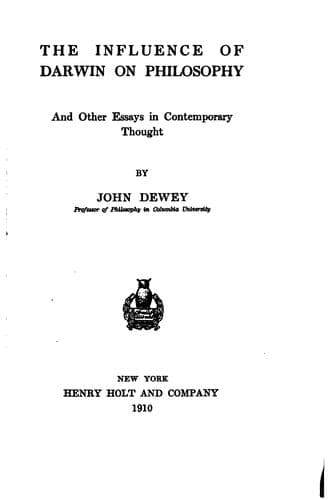
The Influence of Darwin on Philosophy, and other essays in contemporary thoughtDewey, John
Philosophy
The Influence of Darwin on Philosophy, and other essays in contemporary thought
Dewey, John
Evolution; Philosophy; Pragmatism
Contrast this critical period, finding its expression equally in
the art of the Renaissance, the revival of learning, the Protestant
Reformation, and political democracy, with Athens in the time of
Socrates. Then individuals felt their own social life disintegrated,
dissolving under their very feet. The problem was how the value of that
social life was to be maintained against the external and internal
forces that were threatening it. The problem was on the side neither
of the individual nor of progress; save as the individual was seen
to be an intervening instrument in the reconstruction of the social
unity. But with the individual of the fourteenth century, it was not
his own intimate community life which was slipping away from him. It
was an alien and remote life which had finally become his own; which
had passed over into his own inner being. The problem was not how a
unity of social life should be conserved, but what the individual
should do with the wealth of resources of which he found himself the
rightful heir and administrator. The problem looked out upon the
future, not back to the past. It was how to create a new order, both
of modes of individual conduct and forms of social life that should
be the appropriate manifestations of the vigorous and richly endowed
individual.
Hence the conception of progress as a ruling idea; the conception of
the individual as the source and standard of rights; and the problem
of knowledge, were all born together. Given the freed individual, who
feels called upon to create a new heaven and a new earth, and who
feels himself gifted with the power to perform the task to which he is
called:--and the demand for science, for a method of discovering and
verifying truth, becomes imperious. The individual is henceforth to
supply control, law, and not simply stimulation and initiation. What
does this mean but that instead of any longer receiving or assimilating
truth, he is now to search for and create it? Having no longer the
truth imposed by authority to rely upon, there is no resource save
to secure the authority of truth. The possibility of getting at and
utilizing this truth becomes therefore the underlying and conditioning
problem of modern life. Strange as it may sound, the question which
was formulated by Kant as that of the possibility of knowledge, is the
fundamental political problem of modern life.
Public-domain text, read in full here on John Shaqi.
Reviews
Reviews
No reviews yet
Be the first to share your thoughts on this work.
Elsewhere in the archive
Join the Discussion
Join the discussion
Sign in to leave a comment or review.
Sign InorCreate an account