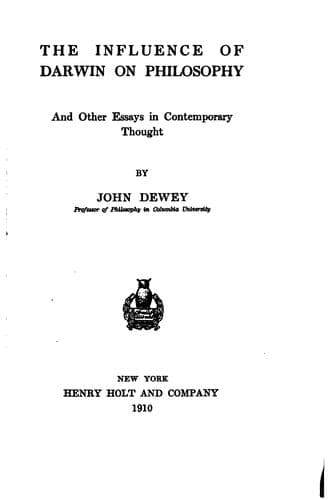
The Influence of Darwin on Philosophy, and other essays in contemporary thoughtDewey, John
Philosophy
The Influence of Darwin on Philosophy, and other essays in contemporary thought
Dewey, John
Evolution; Philosophy; Pragmatism
Science and metaphysics or philosophy, though seeming often to be at
war, with their respective adherents often throwing jibes and slurs
at each other, are really the most intimate allies. The philosophic
movement is simply the coming to consciousness of this claim of the
individual to be able to discover and verify truth for himself,
and thereby not only to direct his own conduct, but to become an
influential and decisive factor in the organization of life itself.
Modern philosophy is the formulation of this creed, both in general and
in its more specific implications. We often forget that the technical
problem “_how_ knowledge is possible,” also means “how _knowledge_ is
possible”; how, that is, shall the individual be able to back himself
up by truth which has no authority save that of its own intrinsic
truthfulness. Science, on the other hand, is simply this general faith
or creed asserting itself in detail; it is the practical faith at work
engaged in subjugating the foreign territory of ignorance and falsehood
step by step. If the ultimate outcome depends upon this detailed and
concrete work, we must not forget that the earnestness and courage, as
well as the intelligence and clearness with which the task has been
undertaken, have depended largely upon the wider, even if vaguer,
operation of philosophy.
But the student of philosophy knows more than that the problem of
knowledge has been with increasing urgency and definiteness the
persistent and comprehensive problem. So conscious is he of the two
opposed theories regarding the nature of science, that he often forgets
the underlying bond of unity of which we have been speaking. These two
opposing schools are those which we know as the sensationalist and the
intellectualist, the empiricist and the rationalist. Admitting that the
dominance of the question of the possibility and nature of knowledge is
at bottom a fundamental question of practice and of social direction,
is _this_ distinction anything more than the clash of scholastic
opinions, a rivalry of ideas meaningless for conduct?
I think it is. Having made so many sweeping assertions I must venture
one more. Fanciful and forced as it may seem, I would say that the
sensational and empirical schools represent in conscious and reflective
form the continuation of the principle of the northern and barbarian
side of medieval life; while the intellectualist and the rationalist
stand for the conscious elaboration of the principle involved in the
Græco-Roman tradition.
Public-domain text, read in full here on John Shaqi.
Reviews
Reviews
No reviews yet
Be the first to share your thoughts on this work.
Elsewhere in the archive
Join the Discussion
Join the discussion
Sign in to leave a comment or review.
Sign InorCreate an account