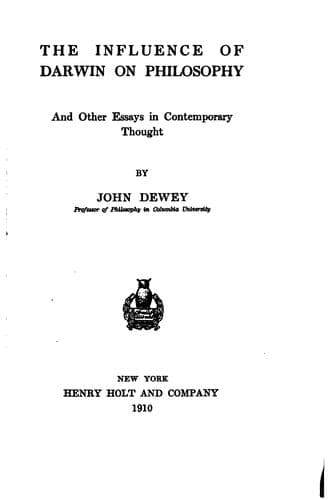
The Influence of Darwin on Philosophy, and other essays in contemporary thoughtDewey, John
Philosophy
The Influence of Darwin on Philosophy, and other essays in contemporary thought
Dewey, John
Evolution; Philosophy; Pragmatism
This suggests, finally, that the next move in philosophy is precisely
to transfer attention from the details of the position assumed, and
the arguments used in these two schools, to the practical motives that
have unconsciously controlled the discussion. The positions have been
sufficiently elaborated. Within the past one hundred years, within
especially the last generation, each has succeeded in fully stating
its case. The result, if we remain at this point, is practically a
deadlock. Each can make out its case against the other. To stop at such
a point is a patent absurdity. If we are to get out of the cul-de-sac
it must be by bringing into consciousness the tacit reference to action
that all the time has been the controlling factor.
In a word, another great rhythmic movement is seen to be approaching
its end. The demand for science and philosophy was the demand for
truth and a sure standard of truth which the new-born individual might
employ in his efforts to build up a new world to afford free scope
to the powers stirring within him. The urgency and acuteness of this
demand caused, for the time being, the transfer of attention from the
nature of practice to that of knowledge. The highly theoretical and
abstract character of modern epistemology, combined with the fact that
this highly abstract and theoretic problem has continuously engaged the
attention of thought for more than three centuries, is, to my mind,
proof positive that the question of knowledge was for the time being
the point in which the question of practice centered, and through which
it must find outlet and solution.
We return, then, to our opening problem: the meaning of the question
of the possibility of knowledge raised by Kant a century ago, and of
his assertion that sensation without thought is blind, thought without
sensation empty. Once more I recall to the student of philosophy
how this assertion of Kant has haunted and determined the course of
philosophy in the intervening years--how his solution at once seems
inevitable and unsatisfactory. It is inevitable in that no one can
fairly deny that both sense and reason are implicated in every fruitful
and significant statement of the world; unconvincing because we are
after all left with these two opposed things still at war with each
other, plus the miracle of their final combination.
When I say that the only way out is to place the whole modern industry
of epistemology in relation to the conditions that gave it birth and
the function it has to fulfil, I mean that the unsatisfactory character
of the entire neo-Kantian movement lies in its assumption that
knowledge gives birth to itself and is capable of affording its own
justification. The solution that is always sought and never found so
long as we deal with knowledge as a self-sufficing purveyor of reality,
reveals itself when we conceive of knowledge as a statement of action,
that statement being necessary, moreover, to the successful ongoing of
action.
Public-domain text, read in full here on John Shaqi.
Reviews
Reviews
No reviews yet
Be the first to share your thoughts on this work.
Elsewhere in the archive
Join the Discussion
Join the discussion
Sign in to leave a comment or review.
Sign InorCreate an account