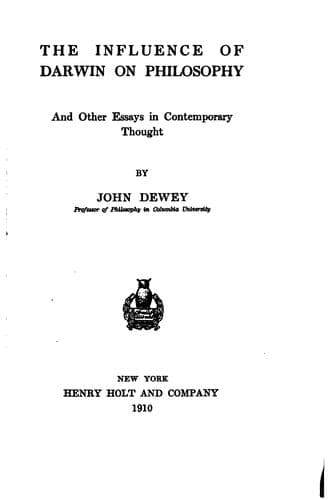
The Influence of Darwin on Philosophy, and other essays in contemporary thoughtDewey, John
Philosophy
The Influence of Darwin on Philosophy, and other essays in contemporary thought
Dewey, John
Evolution; Philosophy; Pragmatism
The entire problem of medieval philosophy is that of absorption,
of assimilation. The result was the creation of the individual.
Hence the problem of modern life is that of reconstruction, reform,
reorganization. The entire content of experience needs to be passed
through the alembic of individual agency and realization. The
individual is to be the bearer of civilization; but this involves a
remaking of the civilization that he bears. Thus we have the dual
question: How can the individual become the organ of corporate action?
How can he make over the truth authoritatively embodied in institutions
of church and state into frank, healthy, and direct expressions of
the simple act of free living? On the other hand, how can civilization
preserve its own integral value and import when subordinated to the
agency of the individual instead of exercising supreme sway over him?
The question of knowledge, of the discovery and statement of truth,
gives the answer to this question; and it alone gives the answer.
Admitting that the practical problem of modern life is the maintenance
of the moral values of civilization through the medium of the insight
and decision of the individual, the problem is foredoomed to futile
failure save as the individual in performing his task can work with
a definite and controllable tool. This tool is science. But this
very fact, constituting the dignity of science and measuring the
importance of the philosophic theory of knowledge, conferring upon
them the religious value once attaching to dogma and the disciplinary
significance once belonging to political rules, also sets their limit.
The servant is not above his master.
When a theory of knowledge forgets that its value rests in solving the
problem out of which it has arisen, viz., that of securing a method of
action; when it forgets that it has to work out the conditions under
which the individual may freely direct himself without loss to the
historic values of civilization--when it forgets these things it begins
to cumber the ground. It is a luxury, and hence a social nuisance and
disturber. Of course, in the very nature of things, every means or
instrument will for a while absorb attention so that it becomes the
end. Indeed it is the end when it is an indispensable condition of
onward movement. But when once the means have been worked out they must
operate as such. When the nature and method of knowledge are fairly
understood, then interest must transfer itself from the possibility of
knowledge to the possibility of its application to life.
Public-domain text, read in full here on John Shaqi.
Reviews
Reviews
No reviews yet
Be the first to share your thoughts on this work.
Elsewhere in the archive
Join the Discussion
Join the discussion
Sign in to leave a comment or review.
Sign InorCreate an account