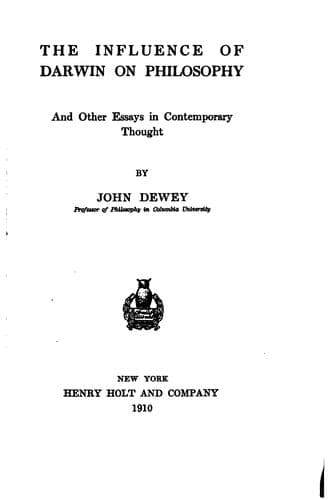
The Influence of Darwin on Philosophy, and other essays in contemporary thoughtDewey, John
Philosophy
The Influence of Darwin on Philosophy, and other essays in contemporary thought
Dewey, John
Evolution; Philosophy; Pragmatism
The sensationalist has played his part in bringing to effective
recognition the demand in valid knowledge for individuality of
experience, for personal participation in materials of knowledge.
The rationalist has served his time in making it clear once for all
that valid knowledge requires organization, and the operation of a
relatively permanent and general factor. The Kantian epistemologist
has formulated the claims of both schools in defining judgment as
the relation of perception and conception. But when it goes on to
state that this relation is itself knowledge, or can be found in
knowledge, it stultifies itself. Knowledge can define the percept and
elaborate the concept, but their union can be found only in action. The
experimental method of modern science, its erection into the ultimate
mode of verification, is simply this fact obtaining recognition. Only
action can reconcile the old, the general, and the permanent with the
changing, the individual, and the new. It is action as progress, as
development, making over the wealth of the past into capital with which
to do an enlarging and freer business, that alone can find its way
out of the cul-de-sac of the theory of knowledge. Each of the older
movements passed away because of its own success, failed because it did
its work, died in accomplishing its purpose. So also with the modern
philosophy of knowledge; there must come a time when we have so much
knowledge in detail, and understand so well its method in general,
that it ceases to be a problem. It becomes a tool. If the problem of
knowledge is not intrinsically meaningless and absurd it must in course
of time be solved. Then the dominating interest becomes the _use_ of
knowledge; the conditions under which and ways in which it may be most
organically and effectively employed to direct conduct.
Thus the Socratic period recurs; but recurs with the deepened meaning
of the intervening weary years of struggle, confusion, and conflict
in the growth of the recognition of the need of patient and specific
methods of interrogation. So, too, the authoritative and institutional
truth of scholasticism recurs, but recurs borne up upon the vigorous
and conscious shoulders of the freed individual who is aware of his
own intrinsic relations to truth, and who glories in his ability to
carry civilization--not merely to carry it, but to carry it on. Thus
another swing in the rhythm of theory and practice begins.
Public-domain text, read in full here on John Shaqi.
Reviews
Reviews
No reviews yet
Be the first to share your thoughts on this work.
Elsewhere in the archive
Join the Discussion
Join the discussion
Sign in to leave a comment or review.
Sign InorCreate an account