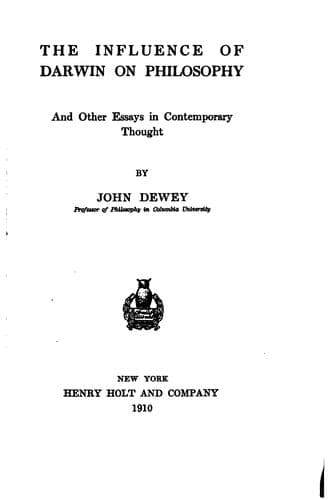
The Influence of Darwin on Philosophy, and other essays in contemporary thoughtDewey, John
Philosophy
The Influence of Darwin on Philosophy, and other essays in contemporary thought
Dewey, John
Evolution; Philosophy; Pragmatism
[22] The same point comes out in Mr. Bradley’s treatment of the way in
which the practical demand for the good or satisfaction is to be taken
account of in a philosophical conception of the nature of reality.
He admits that it comes in; but holds that it enters not directly,
but because if left outside it indirectly introduces a feature of
“discontent” on the intellectual side (see p. 155). This, as an
argument for the supremacy of the isolated theoretical standard, loses
all its force if we cease to conceive of intellect as from the start an
independent function, and realize that intellectual discontent is the
practical conflict becoming deliberately aware of itself as the most
effective means of its own rectification.
[23] This suggests that many of the stock arguments against pragmatism
fail to take its contention seriously enough. They proceed from the
assumption that it is an account of truth which leaves untouched
current notions of the nature of intelligence. But the essential
point of pragmatism is that it bases its changed account of truth on
a changed conception of the nature of intelligence, both as to its
objective and its method. Now this different account of intelligence
may be wrong, but controversy which leaves standing the conventionally
current theories about thought and merely discusses “truth” will not
go far. Since truth is the adequate fulfilment of the function of
intelligence, the question turns on the nature of the latter.
[24] Such a statement as, for example, Mr. Bradley’s (_Mind_, Vol.
XIII., No. 51, N.S., p. 3, article on “Truth and Practice”) “The idea
works ... but is able to work because I have chosen the right idea”
surely loses any argumentative force it may seem to have, when it is
recalled that, upon the theory argued against, ability to work and
rightness are one and the same thing. If the wording is changed to
read “The idea is able to work because I have chosen an idea which is
able to work” the question-begging character of the implied criticism
is evident. The change of phraseology also may suggest the crucial and
pregnant question: How does any one know that an idea is able to work
excepting by setting it at work?
[25] A paper read in the spring of 1909 before the Philosophical Club
of Smith College and not previously published.
[26] Read as the Presidential Address at the fifth annual meeting of
the American Philosophical Association, at Cambridge, December 28,
1905, and reprinted with verbal revisions from the _Philosophical
Review_, Vol. XV., March, 1906. The substitution of the word
“Existences” for the word “Realities” (in the original title) is due
to a subsequent recognition on my part that the eulogistic historic
associations with the word “Reality” (against which the paper was a
protest) infected the interpretation of the paper itself, so that the
use of some more colorless word was desirable.
Public-domain text, read in full here on John Shaqi.
Reviews
Reviews
No reviews yet
Be the first to share your thoughts on this work.
Elsewhere in the archive
Join the Discussion
Join the discussion
Sign in to leave a comment or review.
Sign InorCreate an account