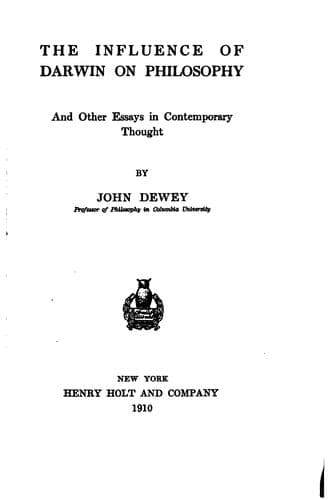
The Influence of Darwin on Philosophy, and other essays in contemporary thoughtDewey, John
Philosophy
The Influence of Darwin on Philosophy, and other essays in contemporary thought
Dewey, John
Evolution; Philosophy; Pragmatism
[14] The association of science and philosophy with leisure, with a
certain economic surplus, is not accidental. It is practically worth
while to postpone practice; to substitute theorizing, to develop a new
and fascinating mode of practice. But it is the excess achievement of
practice which makes this postponement and substitution possible.
[15] It is the failure to grasp the coupling of truth of meaning with
a _specific_ promise, undertaking, or intention expressed by a thing
which underlies, so far as I can see, the criticisms passed upon the
experimental or pragmatic view of the truth. It is the same failure
which is responsible for the wholly _at large_ view of truth which
characterizes the absolutists.
[16] The belief in the _metaphysical_ transcendence of the object of
knowledge seems to have its real origin in an _empirical_ transcendence
of a very specific and describable sort. The thing meaning is one
thing; the thing meant is another thing, and is (as already pointed
out) a thing presented as not given in the same way as is the thing
which means. It is something _to be_ so given. No amount of careful
and thorough inspection of the indicating and signifying things can
remove or annihilate this gap. The _probability_ of correct meaning may
be increased in varying degrees--and this is what we mean by control.
But final certitude can never be reached except experimentally--except
by performing the operations indicated and discovering whether or
no the intended meaning is fulfilled _in propria persona_. In this
experimental sense, truth or the object of any given meaning is always
beyond or outside of the cognitional thing that means it. Error as well
as truth is a necessary function of knowing. But the non-empirical
account of this transcendent (or beyond) relationship puts _all_ the
error in one place (_our_ knowledge), and _all_ the truth in another
(absolute consciousness or else a thing-in-itself).
[17] Compare his essay, “Does Consciousness Exist?” in the _Journal of
Philosophy, Psychology, and Scientific Methods_, Vol. I., p. 480.
[18] Compare the essay on the “Problem of Consciousness,” by Professor
Woodbridge, in the Garman Memorial Volume, entitled “Studies in
Philosophy and Psychology.”
[19] Reprinted, with many changes, from an article in _Mind_, Vol.
XVI., N.S., July 1907. Although the changes have been made to render
the article less technical, it still remains, I fear, too technical
to be intelligible to those not familiar with recent discussions of
logical theory.
[20] I follow chiefly Chapter XV. of “Appearance and Reality”--the
chapter on “Thought and Reality.”
[21] The crux of the argument is contained in Chapters XIII. and XIV.,
on the “General Nature of Reality.”
Public-domain text, read in full here on John Shaqi.
Reviews
Reviews
No reviews yet
Be the first to share your thoughts on this work.
Elsewhere in the archive
Join the Discussion
Join the discussion
Sign in to leave a comment or review.
Sign InorCreate an account