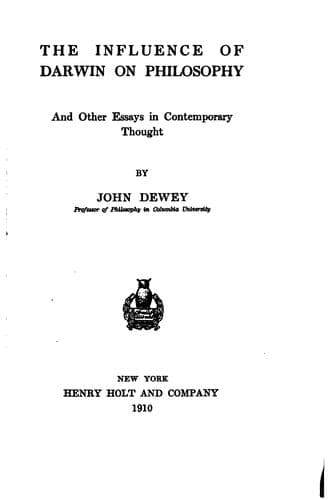
The Influence of Darwin on Philosophy, and other essays in contemporary thought — John Shaqi
The Influence of Darwin on Philosophy, and other essays in contemporary thoughtDewey, John
Philosophy
The Influence of Darwin on Philosophy, and other essays in contemporary thought
Dewey, John
Evolution; Philosophy; Pragmatism
Few words in our language foreshorten intellectual history as much
as does the word species. The Greeks, in initiating the intellectual
life of Europe, were impressed by characteristic traits of the life of
plants and animals; so impressed indeed that they made these traits the
key to defining nature and to explaining mind and society. And truly,
life is so wonderful that a seemingly successful reading of its mystery
might well lead men to believe that the key to the secrets of heaven
and earth was in their hands. The Greek rendering of this mystery,
the Greek formulation of the aim and standard of knowledge, was in
the course of time embodied in the word species, and it controlled
philosophy for two thousand years. To understand the intellectual
face-about expressed in the phrase “Origin of Species,” we must, then,
understand the long dominant idea against which it is a protest.
Consider how men were impressed by the facts of life. Their eyes fell
upon certain things slight in bulk, and frail in structure. To every
appearance, these perceived things were inert and passive. Suddenly,
under certain circumstances, these things--henceforth known as seeds
or eggs or germs--begin to change, to change rapidly in size, form,
and qualities. Rapid and extensive changes occur, however, in many
things--as when wood is touched by fire. But the changes in the living
thing are orderly; they are cumulative; they tend constantly in one
direction; they do not, like other changes, destroy or consume, or
pass fruitless into wandering flux; they realize and fulfil. Each
successive stage, no matter how unlike its predecessor, preserves
its net effect and also prepares the way for a fuller activity on
the part of its successor. In living beings, changes do not happen
as they seem to happen elsewhere, any which way; the earlier changes
are regulated in view of later results. This progressive organization
does not cease till there is achieved a true final term, a τελὸς, a
completed, perfected end. This final form exercises in turn a plenitude
of functions, not the least noteworthy of which is production of germs
like those from which it took its own origin, germs capable of the same
cycle of self-fulfilling activity.
But the whole miraculous tale is not yet told. The same drama is
enacted to the same destiny in countless myriads of individuals so
sundered in time, so severed in space, that they have no opportunity
for mutual consultation and no means of interaction. As an old
writer quaintly said, “things of the same kind go through the same
formalities”--celebrate, as it were, the same ceremonial rites.
Public-domain text, read in full here on John Shaqi.
Reviews
Reviews
No reviews yet
Be the first to share your thoughts on this work.
Join the Discussion
Join the discussion
Sign in to leave a comment or review.
Sign InorCreate an account