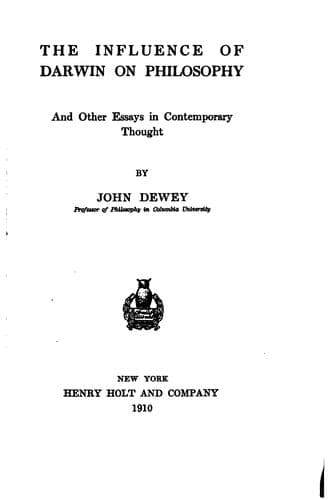
The Influence of Darwin on Philosophy, and other essays in contemporary thoughtDewey, John
Philosophy
The Influence of Darwin on Philosophy, and other essays in contemporary thought
Dewey, John
Evolution; Philosophy; Pragmatism
From this excursion, I return in conclusion to a brief general
characterization of those situations in which we are aware that
things mean other things and are so critically aware of it that, in
order to increase the probability of fulfilment and to decrease the
chance of frustration, all possible pains are taken to regulate the
meanings that attach to things. These situations define that type of
knowing which we call _scientific_. There are things that claim to
mean other experiences; in which the trait of meaning other objects
is not discovered _ab extra_, and after the event, but is part of the
thing itself. This trait of the thing is as realistic, as specific,
as any other of its traits. It is, therefore, as open to inspection
and determination as to its nature, as is any other trait. Moreover,
since it is upon this trait that assurance (as distinct from accident)
of fulfilment depends, an especial interest, an absorbing interest,
attaches to its determination. Hence the scientific type of knowledge
and its growing domination over other sorts.
We _employ_ meanings in all intentional constructions of experience--in
all anticipations, whether artistic, utilitarian or technological,
social or moral. The success of the anticipation is found to depend
upon the character of the meaning. Hence the stress upon a right
determination of these meanings. Since they are the instruments upon
which fulfilment depends _so far as that is controlled_ or other than
accidental, they become themselves objects of surpassing interest. For
all persons at some times, and for one class of persons (scientists)
at almost all times, the determination of the meanings employed in
the control of fulfilments (of acting upon meanings) is central. The
experimental or pragmatic theory of knowledge explains the dominating
importance of science; it does not depreciate it or explain it away.
Possibly pragmatic writers are to blame for the tendency of their
critics to assume that the practice they have in mind is utilitarian
in some narrow sense, referring to some preconceived and inferior
use--though I cannot recall any evidence for this admission. But
what the pragmatic theory has in mind is precisely the fact that
all the affairs of life which need regulation--_all values of all
types_--depend upon utilizations of meanings. Action is not to be
limited to anything less than the carrying out of ideas, than the
execution, whether strenuous or easeful, of meanings. Hence the
surpassing importance which comes to attach to the careful, impartial
construction of the meanings, and to their constant survey and resurvey
with reference to their value as evidenced by experiences of fulfilment
and deviation.
Public-domain text, read in full here on John Shaqi.
Reviews
Reviews
No reviews yet
Be the first to share your thoughts on this work.
Elsewhere in the archive
Join the Discussion
Join the discussion
Sign in to leave a comment or review.
Sign InorCreate an account