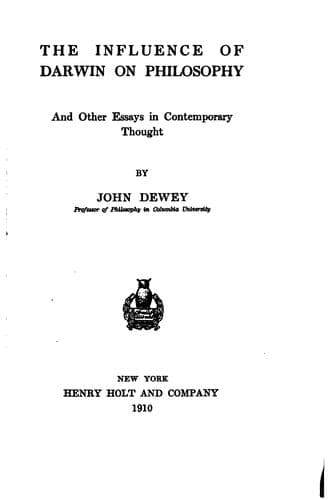
The Influence of Darwin on Philosophy, and other essays in contemporary thoughtDewey, John
Philosophy
The Influence of Darwin on Philosophy, and other essays in contemporary thought
Dewey, John
Evolution; Philosophy; Pragmatism
That truth denotes _truths_, that is, specific verifications,
combinations of meanings and outcomes reflectively viewed, is,
one may say, the central point of the experimental theory. Truth,
in general or in the abstract, is a just name for an experienced
relation among the things of experience: that sort of relation in
which intents are retrospectively viewed from the standpoint of the
fulfilment which they secure through their own natural operation
or incitement. Thus the experimental theory explains directly and
simply the absolutistic tendency to translate concrete true things
into the general relationship, Truth, and then to hypostatize this
abstraction into identity with real being, Truth _per se_ and _in se_,
of which all transitory things and events--that is, all experienced
realities--are only shadowy futile approximations. This type of
relationship is central for man’s will, for man’s conscious endeavor.
To select, to conserve, to extend, to propagate those meanings which
the course of events has generated, to note their peculiarities, to
be in advance on the alert for them, to search for them anxiously, to
substitute them for meanings that eat up our energy in vain, defines
the aim of rational effort and the goal of legitimate ambition. The
absolutistic theory is the transfer of this moral or voluntary law of
selective action into a quasi-physical (that is, metaphysical) law of
indiscriminate being. Identify metaphysical being with _significant
excellent_ being--that is, with those relationships of things which, in
our moments of deepest insight and largest survey, we would continue
and reproduce--and the experimentalist, rather than the absolutist,
is he who has a right to proclaim the supremacy of Truth, and the
superiority of the life devoted to Truth for its own sake over that of
“mere” activity. But to read back into an order of things which exists
without the participation of our reflection and aim, the quality which
defines the purpose of our thought and endeavor is at one and the same
stroke to mythologize reality and to deprive the life of thoughtful
endeavor of its ground for being.
THE INTELLECTUALIST CRITERION FOR TRUTH[19]
I
Public-domain text, read in full here on John Shaqi.
Reviews
Reviews
No reviews yet
Be the first to share your thoughts on this work.
Elsewhere in the archive
Join the Discussion
Join the discussion
Sign in to leave a comment or review.
Sign InorCreate an account