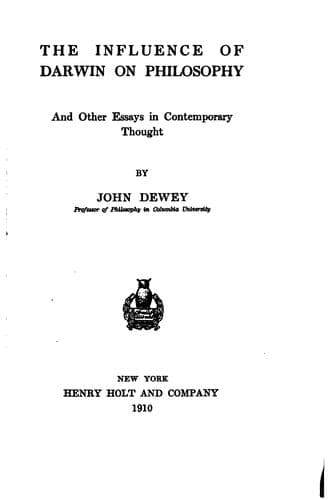
The Influence of Darwin on Philosophy, and other essays in contemporary thoughtDewey, John
Philosophy
The Influence of Darwin on Philosophy, and other essays in contemporary thought
Dewey, John
Evolution; Philosophy; Pragmatism
On this side we reach, I think, the heart of the matter by asking,
in reference to the first quotation: Absolute _for what_? Surely
absolute for the process under consideration, that is absolute for
thought. But the significance of this absolute for thought is, one
may say, “absolutely” (since we are here confessedly in the realm
just of thought) determined by the nature of thought itself. Now
this nature has been already referred by considerations “belonging
irremovably to truth’s proper character,” to the world of appearance
and of internal discrepancy. Yes, one may say (speaking formally),
the criterion of thought is absolute--that is to say absolute or final
for thought; but how can one imagine that this in any way alters the
essential nature and value of thought? If knowledge works by thought,
and thought institutes appearance over against reality, any further
fact about thought--such as a statement of its criterion--falls wholly
within the limits of this situation. It is comical to suppose that a
_special_ trait of thought can be employed to alter the fundamental and
essential nature of thought. The criterion of thought must be infected
by the nature of thought, instead of being a redeeming angel which at
a critical juncture transforms the fragile creature, thought, into an
ambassador with power plenipotentiary to the court of the Absolute.
There really seems to be ground for supposing that the whole argument
turns on an ambiguity in the use of the word “absolute.” Keeping
strictly within the limits of the argument, it means nothing more than
that thinking has a certain principle, a law of its own; that it has
an appropriate mode of procedure which must not be violated. It means,
in short, whatever is finally controlling for the thought-function.
But Mr. Bradley immediately takes the word to mean absolute in the
sense of describing a reality which by its very nature is totally
contradistinguished from appearance--that is to say, from the realm
of thought. Upon the ambiguity of a word, the systematic indictment
of intellectualism becomes the cornerstone of a systematically
intellectualistic method of conceiving reality!
Public-domain text, read in full here on John Shaqi.
Reviews
Reviews
No reviews yet
Be the first to share your thoughts on this work.
Elsewhere in the archive
Join the Discussion
Join the discussion
Sign in to leave a comment or review.
Sign InorCreate an account