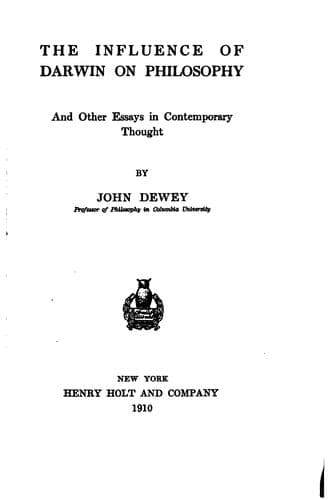
The Influence of Darwin on Philosophy, and other essays in contemporary thoughtDewey, John
Philosophy
The Influence of Darwin on Philosophy, and other essays in contemporary thought
Dewey, John
Evolution; Philosophy; Pragmatism
Admit, however, the force of Mr. Bradley’s contention on its own terms
and see how futile is the result. It is quite true, as Mr. Bradley
says (p. 153), that if a man sits down to play the metaphysical game,
he must abide by the rules of thinking; but if thinking be already,
with respect to reality, an idle and futile game, simply abiding by
the rules does not give additional value to its stakes. Grant the
premises as to the character of thought, and the assertion of the
final character of the theoretical standard within metaphysics--since
metaphysics is a form of theory--is a warning against metaphysics. If
the intellect involves self-contradiction, it is either impossible that
it should be satisfied, or else self-contradiction is its satisfaction.
II
Let us, however, turn from Mr. Bradley’s formal proof that the
criterion of philosophic truth must be exclusively a canon of formal
thought. Let us ignore the contradiction involved in first making the
work of thought to be the producing of appearance and then making
the law of this thought the law of an Absolute Reality. What about
the intellectualist criterion? The intellectualism of Mr. Bradley’s
philosophy is represented in the statement that it is “the theoretical
standard which guarantees that reality is a self-consistent system”
(p. 148). But how can the fact that the criterion of thinking is
consistency be employed to determine the nature of the consistency of
its object? Consistency in one sense, consistency of reasoning with
itself, we know; but what is the nature of the consistency of reality
which this consistency necessitates? Thinking without doubt must be
logical; but does it follow from this that the reality about which
one thinks, and about which one must think consistently if one is to
think to any purpose, must itself be already logical? The pivot of
the argument is, of course, the old ontological argument, stripped of
all theological irrelevancies and reduced to its fighting weight as
a metaphysical proposition. Those who question this basic principle
of intellectualism will, of course, question it here. They will urge
that, instead of the consistency of “reality” resting on the basis of
consistency in the reasoning process the latter derives its meaning
from the material consistency at which it aims. They will say that
the definition of the nature of the consistency which is the end of
thinking and which prescribes its technique is to be reached from
inquiry into such questions as these: What sort of an activity in the
concrete is thinking? what are the specific conditions which it has
to fulfil? what is its use; its relevancy; its purport in present
concrete experiences? The more it is insisted that the theoretical
standard--consistency--is final within theory, the more germane and
the more urgent is the question: What then in the concrete is theory?
and of what nature _is_ the material consistency which is the test of
its formal consistency?[23]
Public-domain text, read in full here on John Shaqi.
Reviews
Reviews
No reviews yet
Be the first to share your thoughts on this work.
Elsewhere in the archive
Join the Discussion
Join the discussion
Sign in to leave a comment or review.
Sign InorCreate an account