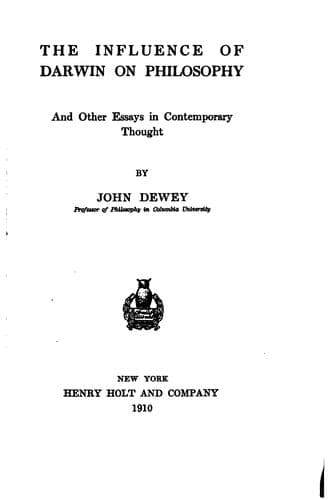
The Influence of Darwin on Philosophy, and other essays in contemporary thoughtDewey, John
Philosophy
The Influence of Darwin on Philosophy, and other essays in contemporary thought
Dewey, John
Evolution; Philosophy; Pragmatism
Grant that intellect is a special movement or mode of practice; grant
that we are not merely acting (are we ever _merely_ acting?) but are
“specially occupied and therefore subject to special conditions,”
and the problem remains _what_ special kind of activity is thinking?
what is its experienced differentia from other kinds? what is its
commerce with them? When the problem is _what_ special kind of an
activity is thinking and of _what_ nature is the consistency which
is its criterion, somehow we do not get forward by being told that
thinking _is_ a special mode of practice and that its criterion _is_
consistency. The unquestioned presupposition of Mr. Bradley is that
thinking is such a wholly separate activity (the “intellect _alone_”
which has to be satisfied), that to give it autonomy is to say that it,
and its criterion, have nothing to do with other activities; that it is
“independent” as to criterion, in a way which excludes interdependence
in function and outcome. Unless the term “special” be interpreted to
mean _isolated_, to say that thinking is a _special_ mode of activity
no more nullifies the proposition that it arises in a practical contest
and operates for practical ends, than to say that blacksmithing is a
_special_ activity, negates its being one connected mode of industrial
activity.
His underlying presupposition of the separate character of thought
comes out in the passage last quoted. “Our impulse,” he says, “is to
alter the conflicting situation and, _on the theoretical side_, to
bring its contents into peaceable unity.” If one substitutes for the
word “on” the word “through,” one gets a conception of theory and of
thinking that does justice to the autonomy of the operation and yet so
connects it with other activities as to give it a serious business,
real purpose, and concrete responsibility and hence testibility.
From this point of view the theoretical activity is simply the form
that certain practical activities take after colliding, as the most
effective and fruitful way of securing their own harmonization.
The collision is not theoretical; the issue in “peaceable unity”
is not theoretical. But theory names the type of activity by which
the transformation from war to peace is most amply and securely
effected.[22]
Public-domain text, read in full here on John Shaqi.
Reviews
Reviews
No reviews yet
Be the first to share your thoughts on this work.
Elsewhere in the archive
Join the Discussion
Join the discussion
Sign in to leave a comment or review.
Sign InorCreate an account