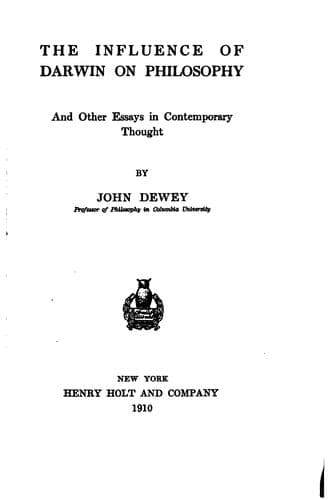
The Influence of Darwin on Philosophy, and other essays in contemporary thoughtDewey, John
Philosophy
The Influence of Darwin on Philosophy, and other essays in contemporary thought
Dewey, John
Evolution; Philosophy; Pragmatism
In any case, how much simpler the case becomes when we stick by the
empirical facts. According to them there is no wholesale discrepancy
of existence and meaning; there is simply a “loosening” of the two
when objects do not fulfil our plans and meet our desires; or when we
project inventions and cannot find immediately the means for their
realization. The “collisions” are neither physical, metaphysical, nor
logical; they are moral and practical. They exist between an aim and
the means of its execution. Consequently the object of thinking is
not to effect some wholesale and “Absolute” reconciliation of meaning
and existence, but to make a specific adjustment of things to our
purposes and of our purposes to things at just the crucial point of
the crisis. Making the utmost concessions to Mr. Bradley’s account
of the discrepancy of meaning and existence in our experience, to
his statement of the relation of this to the function of judgment
(as involving namely an explicit _statement_ at once of the actual
sundering and the ideal union) and to his account of consistency as
the goal and standard, there is still not a detail of the account
that is not met amply and with infinitely more empirical warrant by
the conception that the “collision” in which thinking starts and the
“consistency” in which it terminates are practical and human.
III
This brings us explicitly to the question of truth, “truth” being
confessedly the end and standard of thinking. I confess to being much
at a loss to realize just what the intellectualists conceive to be the
relation of truth to ideas on one side and to “reality” on the other.
My difficulty occurs, I think, because they describe so little in
analytical detail; in writing of truth they seem rather to be under a
strong emotional influence--as if they were victims of an uncritical
pragmatism--which leaves much of their thought to be guessed at. The
implication of their discussions assigns three distinct values to the
term “truth.” On the one hand, truth is something which characterizes
ideas, theories, hypotheses, beliefs, judgments, propositions,
assertions, etc.,--anything whatsoever involving _intellectual_
statement. From this standpoint a criterion of truth means the test
of the worth of the intellectual intent, import, or claim of any
intellectual statement as intellectual. This is an intelligible sense
of the term truth. In the second place, it seems to be assumed that
a certain kind of reality is already, apart from ideas or meanings,
Truth, and that _this_ Truth is the criterion of that lower and more
unworthy kind of truth that may be possessed or aimed at by ideas.
But we do not stop here. The conception that _all_ truth must have a
criterion haunts the intellectualist, so that the reality, which, as
contrasted with ideas, is taken to be The Truth (and the criterion
of _their_ truth) is treated as if it itself had to have support and
warrant from some other Reality, lying back of it, which is _its_
Public-domain text, read in full here on John Shaqi.
Reviews
Reviews
No reviews yet
Be the first to share your thoughts on this work.
Elsewhere in the archive
Join the Discussion
Join the discussion
Sign in to leave a comment or review.
Sign InorCreate an account