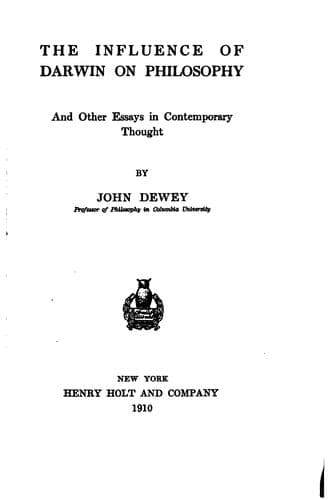
The Influence of Darwin on Philosophy, and other essays in contemporary thoughtDewey, John
Philosophy
The Influence of Darwin on Philosophy, and other essays in contemporary thought
Dewey, John
Evolution; Philosophy; Pragmatism
criterion. This, then, gives the third type of truth, _The Absolute
Truth_. (Just why this process should not go on indefinitely is not
clear, but the necessity of infinite regress may be emotionally
prevented by always referring to this last type of truth as Absolute).
Now this scheme may be “true,” but it is not self-explanatory or even
easily apprehensible. In just what sense, truth is (1) that to which
ideas as ideas lay claim and yet is (2) Reality which as reality is
the criterion of truth of ideas, and yet again is (3) a Reality which
completely annuls and transcends all reference to ideas, is not in the
least clear to me: nor, till better informed, shall I believe it to be
clear to any one.
In his more strictly logical discussions, Mr. Bradley sets out from
the notion that truth refers to intellectual statements and positions
as such. But the Truth soon becomes a sort of transcendent essence
on its own account. The identification of reality and truth on page
146 may be a mere casual phrase, but the distinction drawn between
validity and absolute truth (p. 362), and the discussion of Degrees
of Truth and Reality, involve assumptions of an identity of truth and
reality. Truth in this sense turns out to be the criterion for the
truth, the truth, that is, of ideas. But, again (p. 545), a distinction
is made between “Finite Truth,” that is, a view of reality which would
completely satisfy intelligence as such, and “Absolute Truth,” which is
obtained only by _passing beyond intelligence_--only when intelligence
as such is absorbed in some Absolute in which it loses its distinctive
character.
It would advance the state of discussion, I am sure, if there were
more explicit statements regarding the relations of “true idea,”
“truth,” “the criterion of truth” and “reality,” to one another. A
more explicit exposition also of the view that is held concerning the
relation of verification and truth could hardly fail to be of value.
Not infrequently the intellectualist admits that the process of
verification is experimental, consisting in setting on foot various
activities that express the intent of the idea and confirm or refute
it according to the changes effected. This seems to mean that truth
is simply the tested or verified belief as such. But then a curious
reservation is introduced; the experimental process _finds_, it is
said, that an idea is true, while the error of the pragmatist is to
take the process by which truth is _found_ as one by which it is made.
The claim of “making truth” is treated as blasphemy against the very
notion of truth: such are the consequences of venturing to translate
the Latin “verification” into the English “making true.”
Public-domain text, read in full here on John Shaqi.
Reviews
Reviews
No reviews yet
Be the first to share your thoughts on this work.
Elsewhere in the archive
Join the Discussion
Join the discussion
Sign in to leave a comment or review.
Sign InorCreate an account