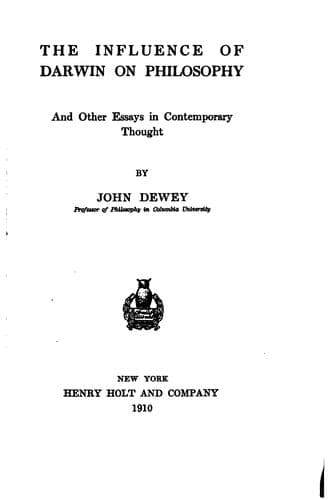
The Influence of Darwin on Philosophy, and other essays in contemporary thoughtDewey, John
Philosophy
The Influence of Darwin on Philosophy, and other essays in contemporary thought
Dewey, John
Evolution; Philosophy; Pragmatism
It is perhaps dangerous to attempt to follow the inner workings of
the processes by which truth is first identified with some superior
type of Reality, and then this Truth is taken as the criterion of the
truth of ideas; while all the time it is held that truth is something
already possessed by ideas as purely intellectual. But there seems
to be some ground for believing that this identification is due to a
twofold confusion, one having to do with ideas, and the other with
things. As to the first point: After an idea is made true, we naturally
say, in retrospect, “it _was_ true all the time.” Now this truism is
quite innocuous as a truism, being just a restatement of the fact that
the idea has, as matter of fact, worked successfully. But it may be
regarded not as a truism but as furnishing some additional knowledge;
as if it were, indeed, the dawning of a revelation regarding truth.
Then it is said that the idea worked or was verified because it was
already inherently, just as idea, the truth; the pragmatist, so it
is said, making the error of supposing that it is true because it
works. If one remembers that what the experimentalist means is that
the effective working of an idea and its truth are one and the same
thing--this working being neither the cause nor the evidence of truth
but its nature--it is hard to see the point of this statement. A
man under peculiarly precarious circumstances has been rescued from
drowning. A by-stander remarks that now he is a saved man. “Yes,”
replies some one, “but he was a saved man all the time, and the process
of rescuing, while it gives evidence of that fact, does not constitute
it.” Now even such a statement as pure tautology, as characterizing the
entire process in terms of its issue, is objectionable only in the fact
that, like all tautology, it seems to say something but does not. But
if it be regarded as revealing the earlier condition of affairs, apart
from the active process by which it was carried to a happy conclusion,
such a statement would be monstrously false; and would declare its
falsity in the fact that, if acted upon, the man would have been left
to drown. In like fashion, to say, _after the event_, that a given
idea was true all the time, is to lose sight of what makes an idea an
idea, its hypothetical character; and thereby deliberately to transform
it into brute dogma--something to which no canon of verification can
ever be applied. The intellectualist almost always treats the pragmatic
account as if it were, from the standpoint of the pragmatist as well as
from his own, a denial of the existence of truth, while it is nothing
but a statement of its nature. When the intellectualist realizes this,
he will, I hope, ask himself: What, then, on the pragmatic basis is
meant by the proposition that an idea is true all the time? If the
statement that an idea was true all the time has no meaning except that
the idea was one which as matter of fact succeeded through action in
Public-domain text, read in full here on John Shaqi.
Reviews
Reviews
No reviews yet
Be the first to share your thoughts on this work.
Elsewhere in the archive
Join the Discussion
Join the discussion
Sign in to leave a comment or review.
Sign InorCreate an account