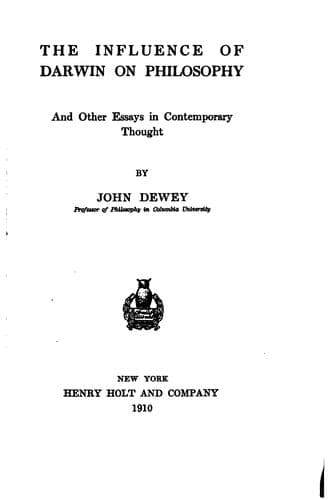
The Influence of Darwin on Philosophy, and other essays in contemporary thoughtDewey, John
Philosophy
The Influence of Darwin on Philosophy, and other essays in contemporary thought
Dewey, John
Evolution; Philosophy; Pragmatism
I hear a noise in the street. It suggests as its meaning a street-car.
To test this idea I go to the window and through listening and
looking intently--the listening and the looking being modes of
behavior--organize into a single situation elements of existence and
meaning which were previously disconnected. In this way an idea is made
true; that which was a proposal or hypothesis is no longer merely a
propounding or a guess. If I had not reacted in a way appropriate to
the idea it would have remained a mere idea; at most a candidate for
truth that, unless acted upon upon the spot, would always have remained
a theory. Now in such a case--where the end to be accomplished is the
discovery of a certain order of facts--would the intellectualist claim
that apart from the forming and entertaining of some interpretation,
the category of truth has either existence or meaning? Will he claim
that without an original practical uneasiness introducing a practical
aim of inquiry there must have been, whether or no, an idea? Must
the world for some purely intellectual reason be intellectually
reduplicated? Could not that occurrence which I now identify as a noisy
street-car have retained, so far as pure intelligence is concerned,
its unidentified status of being mere physical alteration in a vast
unidentified complex of matter-in-motion? Was there any _intellectual_
necessity that compelled the event to arouse just this judgment,
that it meant a street-car? Was there any physical or metaphysical
necessity? Was there any necessity save a need of characterizing
it for some purpose of our own? And why should we be mealy-mouthed
about calling this need practical? If the necessity which led to the
formation and development of an intellectual judgment was purely
objective (whether physical or metaphysical) why should not the thing
have also to be characterized in countless millions of other ways; for
example, as to its distance from some crater in the moon, or its effect
upon the circulation of my blood, or upon my irascible neighbor’s
temper, or bearing upon the Monroe Doctrine? In short, do not
intellectual positions and statements mean new and significant events
in the treatment of things?
Public-domain text, read in full here on John Shaqi.
Reviews
Reviews
No reviews yet
Be the first to share your thoughts on this work.
Elsewhere in the archive
Join the Discussion
Join the discussion
Sign in to leave a comment or review.
Sign InorCreate an account