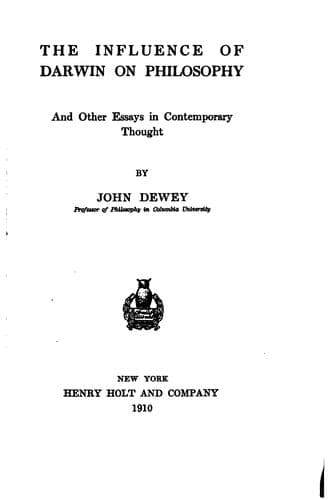
The Influence of Darwin on Philosophy, and other essays in contemporary thoughtDewey, John
Philosophy
The Influence of Darwin on Philosophy, and other essays in contemporary thought
Dewey, John
Evolution; Philosophy; Pragmatism
1. The condition which antecedes and provokes any particular exercise
of reflective knowing is always one of discrepancy, struggle,
“collision.” This condition is practical, for it involves the habits
and interests of the organism, an agent. This does not mean that the
struggle is merely personal, or subjective, or psychological. The
agent or individual is one factor in the situation--not the situation
something subsisting in the individual. The individual has to be
identified in the situation, before any situation can be referred--as
in psychology--to the individual. But the discrepancy calls out and
controls reflective knowing only as the fortunes of an agent are
implicated in the crisis. Certain elements stand out as obstacles,
as interferences, as deficiencies--in short as unsatisfactory and as
requiring something for their completion. Other elements stand out
as wanted--as required, as a satisfaction which does not exist. This
clash (an accompaniment of all desire) between the given and the
wanted, between the present and the absent, is at once the root and
the type of that peculiar paradoxical relation between existence and
meaning which Bradley insists upon as the essence of judgment. It
is not irrational in the sense that we are dealing with appearance
wholesale, but it is non-rational--an evidence that we are dealing with
a practical affair.
2. The intellectual or reflective and logical is a _statement_ of
this conflict: an attempt to describe and define it. It is, as it
were, the practical clash held off at arm’s length for inspection
and investigation. In this way brute blind reaction against the
unsatisfactoriness of the situation is suspended. Action is turned
into the channel of observing, of inferring, of reasoning, or defining
means and end. It is this change in the quality of activity, from
directly overt, to indirect, or inquiring with view to stating, that
constitutes the _specific_ nature of reflective practice to which Mr.
Bradley calls attention. The discovery of the nature of the conflict
supplies materials for the fact or existence side of the judgement.
The conception or projection of the object in which the conflict
would be terminated furnishes material for the meaning side of the
judgment. It is ideal because anticipatory, just as the fact side
is existential, because reminiscent or recording. Hence the two are
necessarily both distinguished from and yet referred to each other:
only through location of a problem can a solution be conceived; only
in reference to the intent of finding a solution can the elements of
a problem be selected and interpreted. In origin and in destiny, this
correlative determination of existence and meaning is tentative and
experimental. The aim of the subject of the judgment is not to include
all possible reality, but to select those elements of a reality that
are useful in locating the source and nature of the difficulty in
hand.
Public-domain text, read in full here on John Shaqi.
Reviews
Reviews
No reviews yet
Be the first to share your thoughts on this work.
Elsewhere in the archive
Join the Discussion
Join the discussion
Sign in to leave a comment or review.
Sign InorCreate an account