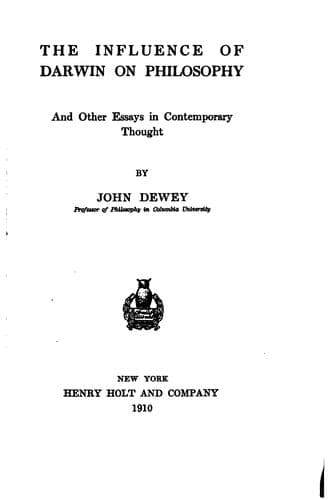
The Influence of Darwin on Philosophy, and other essays in contemporary thoughtDewey, John
Philosophy
The Influence of Darwin on Philosophy, and other essays in contemporary thought
Dewey, John
Evolution; Philosophy; Pragmatism
The aim of the predicate is not to bunch all possible meaning
and refer it in one final act indiscriminately to all existence, but
to state the standpoint and method through which the difficulty of the
particular situation may most effectively be dealt with. The selection
of what is relevant to the characterization of the problem and the
projection of the method of dealing with it are theoretic, hypothetic,
intellectual:--that is, they are tentative ways of viewing the matter
for the sake of guiding, economizing, and freeing the activities
through which it may _really_ be dealt with.
3. The criterion of the worth of the idea is thus the capacity of
the idea (as a definition of the end or outcome in terms of what is
likely to be serviceable as a method) to operate in fulfilling the
object for the sake of which it was projected. Capacity of operation
in this fashion is the test, measure, or criterion of truth. Hence the
criterion is practical in the most overt sense of that term. We may,
if we choose, regard the object in which the idea terminates through
its use in guiding action, as the criterion; but if we so choose, it is
at our peril that we forget that this object serves as criterion in its
capacity of fulfilment and not as sheer objective existence.
4. Difficulties overlap; problems recur which resemble each other
in the kind of treatment they demand for solution. Various modes of
activity with their respective ends, going on at some time more or
less independently, get organized into single comprehensive systems of
behavior. The solution of one problem is found to create difficulties
elsewhere; or the truth that is made in the solution of one problem
is found to afford an effective method of dealing with questions
arising apparently from unallied sources. Thus certain tested ideas
in performing a constant or recurrent function secure a certain
permanent status. The prospective use of such truths, the satisfaction
that we anticipate in their employ, the assurance of control that we
feel in their possession, becomes relatively much more important than
the circumstances under which they were first made true. In becoming
permanent resources, such tested ideas get a generalized energy of
position. They are truths in general, truths “in themselves” or in the
abstract, truths to which positive value is assigned on their own
account. Such truths are the “eternal truths” of current discussion.
They naturally and properly add to their intellectual and to their
practical worth a certain esthetic quality. They are interesting to
contemplate, and their contemplation arouses emotions of admiration
and reverence. To make these emotions the basis of assigning peculiar
inherent sanctity to them apart from their warrant in use, is simply
to give way to that mood which in primitive man is the cause of
attributing magical efficacy to physical things. Esthetically such
truths are more than instrumentalities. But to ignore both the
Public-domain text, read in full here on John Shaqi.
Reviews
Reviews
No reviews yet
Be the first to share your thoughts on this work.
Elsewhere in the archive
Join the Discussion
Join the discussion
Sign in to leave a comment or review.
Sign InorCreate an account