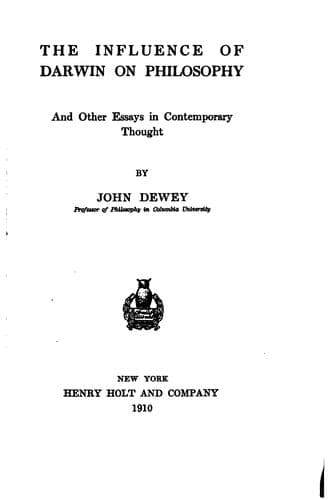
The Influence of Darwin on Philosophy, and other essays in contemporary thoughtDewey, John
Philosophy
The Influence of Darwin on Philosophy, and other essays in contemporary thought
Dewey, John
Evolution; Philosophy; Pragmatism
instrumental and the esthetic aspect, and to ascribe values due to an
instrumental and esthetic character to some interior and _a priori_
constitution of truth is to make fetishes of them.
We may not exaggerate the permanence and stability of such truths with
respect to their recurring and prospective use. It is only relatively
that they are unchanging. When applied to new cases, used as resources
for coping with new difficulties, the oldest of truths are to some
extent remade. Indeed it is only through such application and such
remaking that truths retain their freshness and vitality. Otherwise
they are relegated to faint reminiscences of an antique tradition. Even
the truth that two and two make four has gained a new meaning, has had
its truth in some degree remade, in the development of the modern
theory of number. If we put ourselves in the attitude of a scientific
inquirer in asking what is the meaning of truth _per se_, there spring
up before us those ideas which are actively employed in the mastery
of new fields, in the organization of new materials. This is the
essential difference between truth and dogma; between the living and
the dead and decaying. Above all, it is in the region of moral truth
that this perception stands out. Moral truths that are not recreated in
application to the urgencies of the passing hour, no matter how true
in the place and time of their origin, are pernicious and misleading,
_i.e._, false. And it is perhaps through emphasizing this fact,
embodied in one form or another in every system of morals and in every
religion of moral import, that one most readily realizes the character
of truth.
A SHORT CATECHISM CONCERNING TRUTH[25]
_Pupil._ I am desirous, respected teacher, of forming an independent
judgment concerning the novel theory of truth that you are said to
profess. My eagerness is whetted because the theory as expounded
to me by my old teacher, Professor Purus Intellectus, so obviously
contravenes common sense, science, and philosophy that I do not
understand how it can be advanced in good faith by any reasonable man.
_Teacher._ As you are already somewhat acquainted with the theory (or
at least with what it purports to be), perhaps if you will set forth
in order your objections, it will appear that the theory that you are
acquainted with is not advanced by any reasonable persons, and that by
understanding the theory as it is you will also be led to embrace it.
_Pupil: Objection One._ Pragmatism makes truth a subjective affair,
namely the satisfaction afforded individuals by ideas, while everybody
knows that the truth of ideas depends upon their relation to things.
Public-domain text, read in full here on John Shaqi.
Reviews
Reviews
No reviews yet
Be the first to share your thoughts on this work.
Elsewhere in the archive
Join the Discussion
Join the discussion
Sign in to leave a comment or review.
Sign InorCreate an account