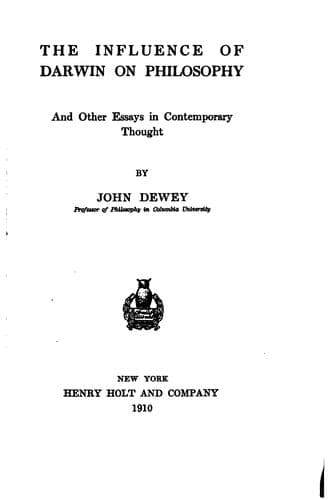
The Influence of Darwin on Philosophy, and other essays in contemporary thoughtDewey, John
Philosophy
The Influence of Darwin on Philosophy, and other essays in contemporary thought
Dewey, John
Evolution; Philosophy; Pragmatism
_Pupil: Objection Five._ But your argument requires an absurd
identification of truth and verification. To verify ideas is to find
out that they were already true; or possessed of the truth relation
prior to its discovery in verification. But the pragmatist holds that
the act of finding out that ideas are true creates the thing that is
found. In short, you confuse the psychology of finding out with the
reality found out.
_Teacher: Reply._ Many intellectualists have now gone so far as
to admit that _verification_ is the testing of a judgment by the
consequence it imports, the difference it makes--its working. But
they still deny any organic connection between the “antecedent” truth
property of ideas and the verification (or “making true”) process.
Surely they admit either too much or too little. (i) If an idea
about a past event is already true because of some mysterious static
correspondence that it possesses to that past event, how in the world
can its truth be _proved_ by the _future consequences_ of that idea?
Why is it that the intellectualist has not produced any positive
theory about the relation of verification to his notion of truth?
(ii) Moreover, if verification consists in the experimental working
out of a belief, the intellectualist thereby admits that his _own_
theory of truth can be _known_ to be true only as it is verified by
its workings. But if the theory that truth is a ready-made static
property of judgments _is_ true, how in the world _can_ it be verified
by making any specific differences in the course of events? Everywhere
we have to proceed _as if_ the pragmatic theory were the right one.
(iii) If he admits that the pragmatic theory of verification is true,
what meaning remains to the statement that the idea had the truth
property in advance? Why, simply that it had the property of _ability
to work_--an ability revealed by its actual working. How can a given
fact be an objection to the pragmatic theory when that fact has a
definitely assignable meaning on the pragmatic theory, while upon
the anti-pragmatic theory it just has to be accepted as an ultimate,
unanalyzable fact?
As to your remark about verification being merely psychological, I have
something to say. Colleagues of mine are steadily at work in various
laboratories on various researches, forming hypotheses, experimenting,
testing, corroborating, refuting, modifying ideas. One of them, for
example, recently put an immense pendulum in place in order to repeat
and test Foucault’s experiment with reference to the earth’s rotation.
Do you regard such verification processes as merely psychological?
_Pupil._ I don’t know. Why do you ask?
Public-domain text, read in full here on John Shaqi.
Reviews
Reviews
No reviews yet
Be the first to share your thoughts on this work.
Elsewhere in the archive
Join the Discussion
Join the discussion
Sign in to leave a comment or review.
Sign InorCreate an account