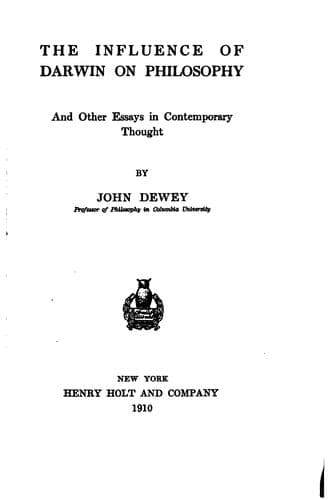
The Influence of Darwin on Philosophy, and other essays in contemporary thoughtDewey, John
Philosophy
The Influence of Darwin on Philosophy, and other essays in contemporary thought
Dewey, John
Evolution; Philosophy; Pragmatism
_Teacher._ Because if the objector means that such experimental
provings are _merely_ psychological, he has of course relegated to the
merely psychological (wherever that may be) all the technique of all
the physical sciences--a rather high price to pay for the confutation
of the pragmatist. The intellectualist is thus in the dilemma either
of conceding to the pragmatist the whole sphere of concrete scientific
logic or else of himself regarding all science as merely subjective?
Which horn does he choose?
_Pupil: Objection Six._ I noticed a moment ago that you spoke of the
pragmatic theory of truth being true. Surely the pragmatist does not
live up to his reputation of having a sense of humor when he claims
assent to his theory on the ground that it is true. What is this but to
admit intellectualism?
_Teacher: Reply._ My son, we are evidently nearing the end. Naturally,
the pragmatist claims his theory to be true in the pragmatic sense of
truth: it works, it clears up difficulties, removes obscurities, puts
individuals into more experimental, less dogmatic, and less arbitrarily
sceptical relations to life; aligns philosophic with scientific
method; does away with self-made problems of epistemology; clarifies
and reorganizes logical theory, etc. He is quite content to have the
truth of his theory consist in its working in these various ways, and
to leave to the intellectualist the proud possession of a static,
unanalyzable, unverifiable, unworking property.
_Pupil: Objection Seven._ Nevertheless, the pragmatist is always
appealing to the judgments of others to corroborate his own judgment.
Surely this admits the principle of a judgment that is correct, true,
_in se_.
_Teacher: Reply._ The pragmatist says that judgment _is_ pragmatic,
_i.e._, originated under conditions of need for a survey and statement,
and tested by efficiency in meeting this need. And then you think
you have refuted him by saying that any appeal to judgment is
intellectualistic! Such begging of the question convinces me that the
radical difficulty of the intellectualist is that he conceives of the
pragmatist as beginning with a theory of truth, when in reality the
latter begins with a theory about judgments and meanings of which the
theory of truth is a corollary.
_Pupil: Objection Eight._ Nevertheless, you are endeavoring to convert
your opponent to a certain theory. Surely that is an intellectual
undertaking, and in theory (at least) the theoretical criterion, as Mr.
Bradley has well said, must be supreme.
Public-domain text, read in full here on John Shaqi.
Reviews
Reviews
No reviews yet
Be the first to share your thoughts on this work.
Elsewhere in the archive
Join the Discussion
Join the discussion
Sign in to leave a comment or review.
Sign InorCreate an account